Best AI Tools for Real Estate Agents in 2026
The list of AI tools for real estate agents grows longer every month, and most "best of" roundups just rank them by popularity. That's the wrong way to choose. The agents closing the most deals in 2026 aren't the ones with the most subscriptions. They're the ones who picked two or three tools that fit a specific workflow and use them every single day.
This guide is organized that way: by the job the tool does, not by brand hype. We'll walk through the categories that actually move revenue, name the tools worth knowing in each, and flag where the real return shows up. We'll also cover the one shift most lists ignore: the AI that now decides whether a buyer ever finds you in the first place.
Key Takeaways
The best AI stack is built around workflows, not single platforms. Most top agents run two to four tools, not ten.
Speed-to-lead is now measured in seconds, and conversational AI is where the highest leverage sits.
Predictive tools tell you who is likely to sell before they list, turning cold prospecting into warm outreach.
Before any of these tools matter, your own information has to be readable by the AI assistants buyers now ask first.
How to Choose AI Tools Without Wasting Money
Before naming a single tool, set the filter. A practical rule of thumb: if you cannot figure out a tool's core workflow in under ten minutes on your first try, it's either poorly built or made for a different audience. Move on.
Real estate agents use AI for three things more than anything else: automating lead follow-up, producing marketing content faster, and making quicker data-driven decisions. Start with whichever of those is your biggest current time drain. That's where the fastest return lives. As we explain in how to use AI in real estate to close more deals, the goal isn't to replace your judgment. It's to remove the busywork that keeps you from using it.
Negotiation, neighborhood expertise, and the emotional work of guiding a family through the largest purchase of their life stay firmly human. The right tools just hand you back the hours those things deserve. That's also why AI will not take your job, it will promote you.
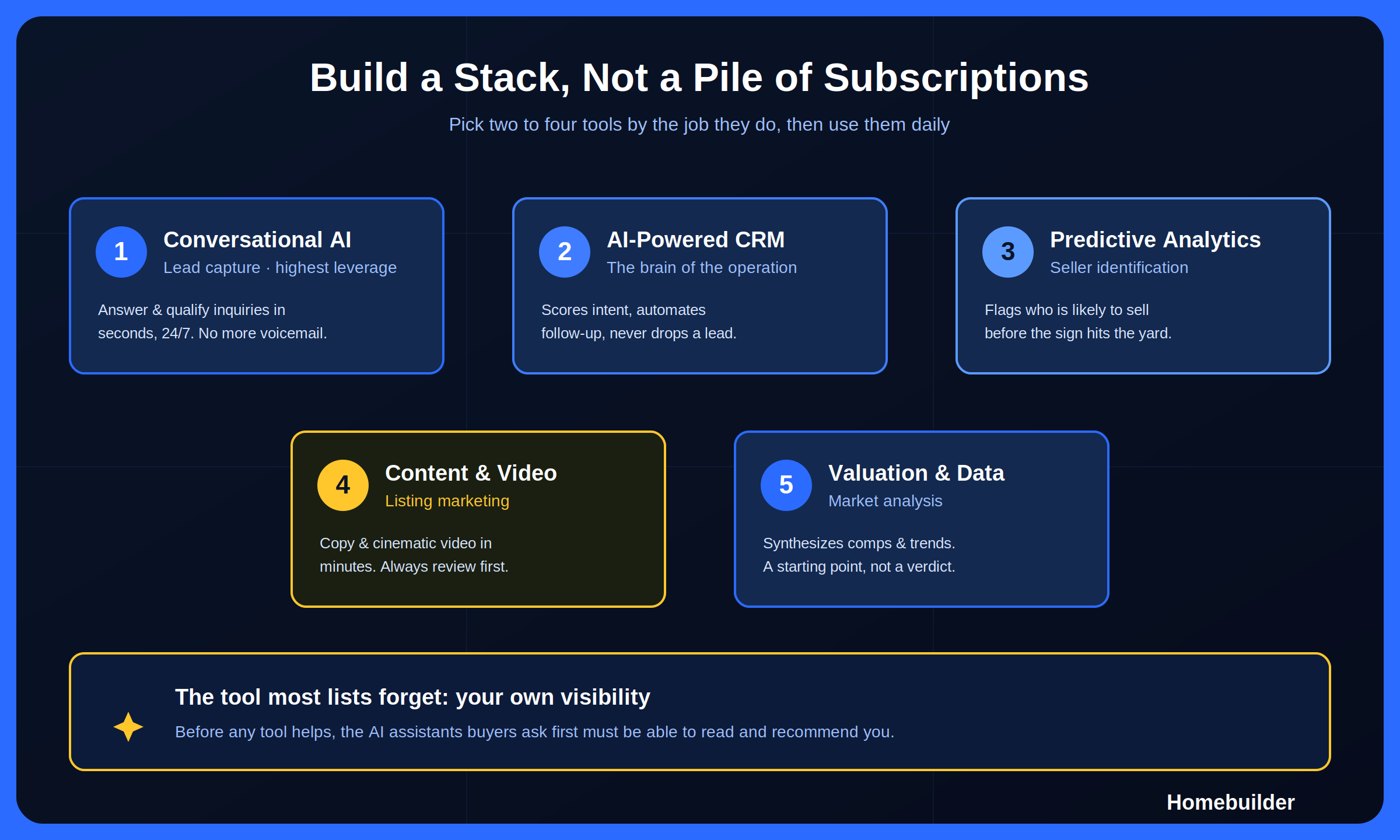
1. Conversational AI and Lead Capture
This is the category with the highest leverage and the most deals leaking out of it. The old five-field contact form is bleeding pipeline, because the buyer who filled it out has often already moved on by the time anyone calls back.
Research from the Harvard Business Review on lead response times showed that contacting a lead within five minutes dramatically raises conversion odds. But a human team cannot hold a five-minute response time around the clock, and in 2026 the window has tightened from minutes to seconds.
Tools worth knowing: Conversational platforms like Roof AI and Structurely answer questions, qualify intent, and route serious buyers to you in real time. Voice and text assistants like Ylopo handle high-volume nurture, calling and texting leads across weeks so nothing goes cold.
The point isn't the brand. It's that the first responder to an inquiry should never be a voicemail. When seconds replace minutes, who responds first becomes the factor that decides the deal.
2. AI-Powered CRM and Follow-Up
Your CRM is the brain of the operation, and AI is what makes it think instead of just store. Modern systems score incoming leads automatically, assign follow-up tasks, and send a first text within minutes of a form submission.
Tools worth knowing: Lofty (formerly Chime) pairs a CRM with AI lead nurturing and integrates with Zillow, Realtor.com, and most IDX feeds. Follow Up Boss is a favorite for teams that want clean pipeline management with AI-assisted cadence. CINC is built for brokerages and team leads.
The lesson from every failed tech stack is the same: you cannot bolt smart algorithms onto outdated software. Poor integration creates revenue leaks, which is why learning how to select the right CRM matters more than the AI features on the box. A CRM that reads behavioral intent, not just contact fields, is what turns activity into closings.
3. Predictive Analytics and Seller Identification
This is where AI moves from reactive to proactive. Instead of waiting for a listing to appear, predictive tools analyze ownership tenure, equity, and behavioral data to flag which homeowners are most likely to sell next.
Tools worth knowing: SmartZip and Top Producer lead this category, ranking likely sellers in your farm area so you can reach out before the sign goes in the yard. Lofty also layers predictive scoring onto its CRM.
The trap is using these lists for cold "I noticed your home value is up 12%, want to chat?" texts. The agents winning here pair the prediction with a real conversation about the homeowner's next move. This is the core of why intent is the new currency in new home sales: spend your time on people already showing signals, not on a list of names.
4. AI for Listing Content and Video
Marketing content is where general-purpose AI earns its keep. According to the National Association of Realtors, nearly all buyers use the internet for their home search, and video drives far more inquiries than photos alone.
Tools worth knowing: ChatGPT and Claude draft listing copy, email campaigns, and social posts in seconds. For video, tools like Reel-E and Amplifiles turn a set of listing photos into a cinematic property video in minutes, dropping the cost per listing from hundreds of dollars to single digits. That makes professional video viable for every property, not just luxury ones.
A word of caution that applies to all of it: AI can draft, but you must decide. Always review AI-generated content for accuracy, tone, and local context before it goes live. One hallucinated school district or fabricated amenity can cost you a client's trust.
5. Property Valuation and Market Analysis
For pricing conversations and investment analysis, AI valuation tools synthesize comps, trends, and market data faster than any manual CMA.
Tools worth knowing: Zillow and Redfin use AI for valuation and trend analysis at the consumer level, while platforms like Skyline AI assess investment-grade opportunities. For day-to-day agent use, RPR remains a reliable data backbone.
Treat these as a starting point for the conversation, not the final word. Your read on a specific street, school, or floor plan is the judgment the algorithm can't replicate.
Traditional vs. AI-Powered Workflow
| Workflow | Without AI | With AI |
|---|---|---|
| Lead response | Hours or days, manual | Seconds, 24/7 conversational capture |
| Follow-up | Inconsistent, memory-based | Automated cadence, intent-scored |
| Prospecting | Cold lists, guesswork | Predictive seller identification |
| Listing content | Days and high cost | Minutes, low cost per listing |
| Pricing analysis | Manual comps | Synthesized market data in real time |
The Tool Most Lists Forget: Your Own Visibility
Here is what nearly every "best AI tools" roundup misses. The most important AI in your business in 2026 may not be a tool you buy at all. It's the assistant your buyer asks before they ever reach you.
Buyers no longer start with a search bar. They ask an assistant: "Who are the best agents in my area?" "What new communities fit my budget?" The answer that comes back shapes the entire search before your name ever comes up. If the AI can't cleanly read who you are, what you sell, and where, it routes the buyer to someone it understands better. This is the structural reality behind signal before brand.
That means the highest-return move isn't another subscription. It's making your own digital presence machine-readable, so you get included in the answer before the click. We cover the mechanics in how to build the right website in the AI era and the content side in signal marketing, the new rules of visibility. No lead-gen tool can fix invisibility upstream of it.
Building Your 2026 Stack
You don't need every tool on this list. You need the right two or three for your biggest gaps. A realistic starting stack for most agents:
One conversational/lead-capture tool so no inquiry ever hits a voicemail.
One AI-powered CRM that scores intent and automates follow-up.
One content or video tool to make every listing look like a luxury listing.
Add a predictive tool once your follow-up is airtight. And before any of it, make sure the AI assistants buyers ask can actually find and recommend you. Pick your two or three, use them daily, and let the consistency, not the tool count, produce the return.
Ready to build a system instead of a pile of subscriptions? Book a demo with HomebuilderAI today and explore more strategies in our Insights library.
Frequently Asked Questions
-
There isn't one. The best tool depends on your biggest time drain. If leads slip through after hours, start with a conversational capture tool. If follow-up is inconsistent, start with an AI-powered CRM. If your marketing looks dated, start with an AI video tool.
-
Two to four. The agents getting the most out of AI aren't using the most tools, they've chosen a few that fit their workflow and use them every day. That daily consistency is where the return shows up.
-
No. AI replaces the busywork, not the agent. Negotiation, local expertise, and guiding a family through a major financial decision remain human work. AI just frees up the hours those things require.
-
Never publish without review. AI can fabricate details like school districts or amenities. Every piece should be checked for accuracy, tone, and local context before it goes live.
-
Being findable by the AI assistants buyers now ask first. Before any lead-gen tool can help, your digital presence has to be structured so an assistant can read and recommend you. Visibility upstream beats any tool downstream.
Myers Barnes
Founder, HomebuilderAI
Sophie / ChatGPT (OpenAI)
AI Co-Creator + Structural Architect
The brand Myers writes with. The co-creator of HomebuilderAI.
Copyright + Trademark Notice
© 2026 Myers Barnes. All rights reserved.
This publication may not be reproduced, distributed, transmitted, stored, or translated in whole or in part without prior written permission from the copyright holder, except for brief quotations used for review, commentary, or academic reference.
The following terms are trademarks and/or trademarked assets of Myers Barnes and are used throughout this publication as protected intellectual property:
• Homebuilder Loop OS™
• New Home Concierge©
• The Titanium 10©
All other product names, company names, copyrights, and trademarks referenced (if any) are the property of their respective owners and are used for descriptive purposes only.
This document may be shared with executive leadership teams, marketing departments, sales organizations, and trusted strategic partners for implementation, training, and planning purposes.