Enterprise Language Portfolios: The Evolution of Domain Names from SEO Assets to AI-Native Linguistic Infrastructure
A Research-Based Framework for Understanding, Valuing, and Deploying Category-Defining Noun Domains in the Age of Conversational AI
Myers Barnes
Founder, HomebuilderAI
Creator, HomebuilderLoop OS™
Claude
Strategic Architect
Every great home has an architect and a builder. In this paper, I'm the architect: forty-plus years of field experience, judgment, and vision. Claude is the builder: assembling, drafting, and stress-testing the structure I designed. Neither replaces the other. That's exactly how HomebuilderAI is meant to work.
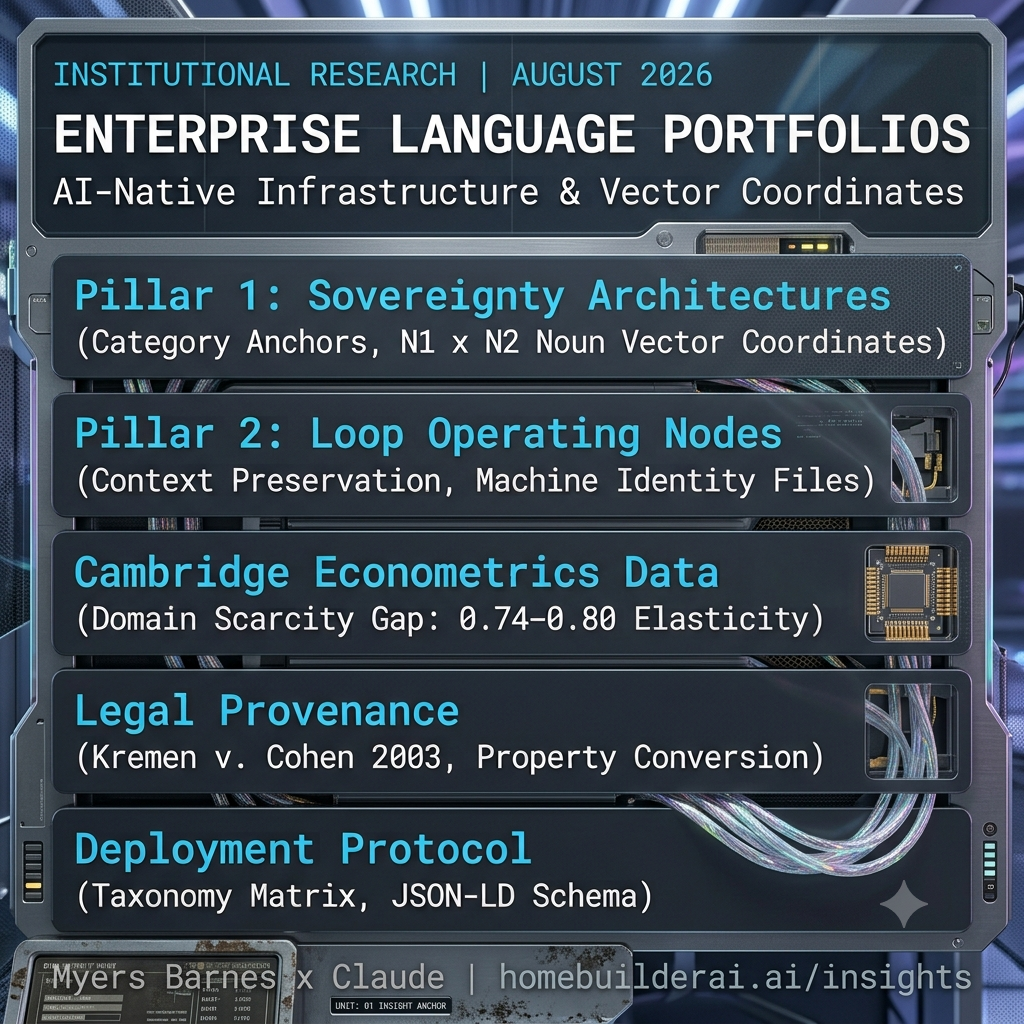
PRELUDE
The Question We Stopped Asking
A man walks into a library. He looks around. Thousands of books. Thousands of ideas. He asks the librarian, "How do I find what I'm looking for?" The librarian points to a wall of unlabeled shelves.
It sounds like a joke. It sounds ridiculous.
But that is exactly how we have been treating domain names for the last thirty years.
We registered names like we were guessing. We chased single-word .coms like lottery tickets. We bought what sounded good, what was available, or what we could flip for a profit. We regarded domains solely as addresses.
Our portfolios were assembled haphazardly, lacking cohesion and structure.
Then, the ground shifted. AI arrived. And it didn't need a website to find an answer. It needed a noun. A category. A concept.
All of a sudden, the old way of thinking about domains was obsolete. AI wasn't searching for keywords. It was recognizing entities. It was reading domains as signals. It was organizing knowledge around categories, not clicks.
The previous methodology, which involved purchasing arbitrary domains, prioritizing individual words, and considering them merely as addresses, relied on one vulnerable presumption: that domains function solely as pointers to websites.
That assumption is structurally invalid.
Domains are no longer addresses. They are linguistic infrastructure. They are the coordinates that AI uses to navigate knowledge. They are the finite vocabulary of a machine-readable world.
This paper is about that shift.
It is about the evolution of domains from SEO assets to AI-native linguistic infrastructure. It is about the scarcity of category-defining nouns. It is about the architecture of an enterprise language portfolio.
And it is about how to understand, value, and deploy the most important digital assets of the AI era.
FOREWORD
Why This Paper Exists
For decades, domain names were treated as addresses. You bought one, pointed it to a website, and moved on. The goal was simple: be findable.
That era is over.
Domains have evolved. They are no longer just addresses. They are linguistic assets. They are semantic anchors. They are the coordinates that AI uses to organize knowledge, recognize entities, and surface relevant answers.
This paper exists because most people still think about domains the old way. They chase single-word .com names. They treat domains as branding exercises. They ignore the structural shift that has already happened.
The shift is this: AI reads domains. AI interprets domains. AI uses domains to categorize, trust, and contextualize. In a world where the first interaction is machine-to-machine, the domain is no longer just an address; it's a signal.
At the same time, the vocabulary of commercially meaningful category nouns is finite. There are only so many words that define industries, concepts, and enterprise categories. Every time one of those words gets claimed, the remaining supply shrinks.
This creates a structural asymmetry. Finite supply. Growing demand. Increasing value.
This paper is a research-based framework for understanding that shift. It explains why category-defining noun domains are among the most valuable linguistic assets in the AI-native economy. It shows how a portfolio of related domains functions as an architecture, not a collection.
It is written for domain brokers, strategic buyers, and investors who understand that the rules have changed.
It is written for anyone who wants to own the vocabulary of the future.
CHAPTER 1
AI Is Math. Nouns Are the Vocabulary of That Math.
To understand why domains have evolved from addresses to infrastructure, you must first understand what AI actually is.
AI is math. It is not magic. It is not consciousness. It is not a brain in a box. It is applied mathematics, executed billions of times per second, transforming inputs into outputs through a predictable, learnable process.
That chain follows a consistent pattern:
It starts as Algebra. AI views words, images, and data as massive grids of numbers called matrices. It uses linear algebra to add, multiply, and shift these grids to find patterns. Every word, every image, every idea becomes a set of numbers.
Then to Geometry. AI plots those algebraic numbers as coordinates in a massive, invisible geometric space. Words with similar meanings are mathematically placed close together. The distance between words becomes a measure of their relatedness.
Then to Calculus. This is how AI learns. It calculates its own errors using derivatives and gradients. It constantly tweaks its internal numbers to reduce error as close to zero as possible. Every improvement is a calculus problem being solved at enormous scale.
And extends into Dynamic Systems. Numerous contemporary AI architectures incorporate mathematical frameworks foundational to physics, including probability theory, energy landscapes, diffusion equations, and stochastic processes. These are the tools that let AI systems generate, refine, and reason.
When you ask a chatbot a question, this is the chain executing billions of times per second. The math is unyielding. There is no interpretation. There is only calculation.
This is where the noun-verb distinction becomes critical.
In AI's mathematical space, nouns and verbs function differently.
Nouns are coordinates. They are stable points in the geometric space. A noun like "Data" has a fixed position. "Sovereignty" has a fixed position. Signal has a fixed position. These coordinates can be referenced, categorized, and retrieved.
Verbs are vectors. Verbs like "Get," "Build," and "Manage" indicate direction, action, or process. Without a noun, a verb lacks a destination.
This is not a grammatical preference. It is a structural reality of how AI processes language.
The implication for domains is direct.
A noun domain like datasovereignty.ai is a stable coordinate in AI's semantic space. It is a point that can be referenced, categorized, and retrieved. AI recognizes it as a concept, not an instruction.
A verb domain like getdatasovereignty.ai is a vector, a path to somewhere else. AI recognizes it as a query or an instruction, not as a destination for knowledge.
This is why conversational AI depends on nouns. When a user asks, "Show me data sovereignty solutions," the AI identifies the noun, "data sovereignty," and searches for content anchored to that concept.
The distinction is structural. Verbs are temporary instructions. Nouns are permanent categories.
The finite vocabulary of nouns creates structural scarcity.
Natural language contains a limited number of universally understood commercially meaningful category nouns. These are the words that identify concepts, disciplines, industries, objects, and classes.
Verb phrases behave differently. Because verbs can be combined with an enormous range of objects, modifiers, and contexts, the number of possible verb-based domains expands combinatorially. New verb phrases can always be created.
Category nouns do not exhibit that same combinatorial growth. Their supply is constrained by the vocabulary itself.
This creates a structural asymmetry. As enterprise-grade noun domains are registered, the remaining inventory of available category language necessarily contracts. Every acquisition permanently removes a coordinate from the available namespace.
This is not opinion. It is linguistics, combinatorics, and economics.
The conclusion is clear:
AI is math. Nouns are the coordinates in that math. Verbs are paths between coordinates.
The vocabulary of enterprise-grade category nouns is finite. Verb phrases are effectively infinite.
Therefore, owning the finite set of category-defining nouns is owning the coordinate system of the AI-native enterprise.
You cannot build on a verb. A verb is a path to somewhere else.
You can build on a noun. A noun is a destination for knowledge, products, services, and AI reasoning.
This is why noun domains are not just addresses. They are infrastructure.
From Category Killer to Category Coordinate
For nearly two decades, the single-word domain was the ultimate prize. A short, exact-match .com was called a "category killer" and the name was earned. Search engines rewarded keyword density. Buyers typed brand names directly into browser bars. Brevity was the whole game. Owning the one word was owning the category, because the machine reading it was matching strings, not meaning.
That mechanism is not wrong. It simply belongs to a different era, built for a different kind of reader.
The AI-native mechanism described throughout this chapter rewards something else entirely. An embedding model does not search for the shortest match. It searches for the most precise coordinate; the phrase that maps cleanly onto a real, recognizable category. A single word is often too broad, too ambiguous, or too disconnected from context to serve that function well. "Sovereignty" alone could mean a hundred different things to a hundred different systems. "CRM Sovereignty" or "Data Sovereignty" is unambiguous. It names the exact category, in the exact register an AI system was trained to recognize.
This is why the multi-word, natural-language noun compound is not a compromise inherited from scarcity and not a lesser asset acquired. It’s only because the single perfect word was already gone. It is a different, more precise kind of asset, built for a different kind of reader. The category killer answered the question: how do I rank, and how do I get remembered? The category coordinate answers a different question: how do I get recognized, categorized, and trusted by a system that reasons about language mathematically?
Those are not the same question. That is why the same asset does not answer both and why the shift from single-word to multi-word is not a step down. It is the correct asset for the mechanism actually in play.
The SEO era rewarded the shortest possible signal. The AI era rewards the most precise one.
CHAPTER 2
THE END OF AN ERA: THE PRESSURE CHAMBER VERDICT
For decades, the domain industry operated on a simple assumption: domains are addresses. You register one, point it to a website, and hope people find it. The value of a domain was measured by its length, its extension, and its keyword strength.
That assumption is structurally invalid.
We know this because we can run the old model against a simple test: hold it up against the conditions of the modern AI environment and ask whether it still functions. Call this test the Pressure Chamber, not a laboratory, but a discipline. It's the set of questions any domain strategy has to survive if it's going to hold up in an AI-native world.
What Is the Pressure Chamber?
The Pressure Chamber is a framework, not an instrument. It asks the same seven questions of any domain model, and the old address-based approach fails all seven:
Memory. Does the architecture preserve what has already been learned? Or does information fragment and disappear the moment a session ends?
Continuity. Does the architecture maintain context as information moves between systems? Or does the buyer encounter repeated resets, forced to re-explain themselves at every turn?
Accumulated Intent. Does the architecture recognize that buyer intent develops over time? Or does it treat every interaction as a new beginning, throwing away everything learned in the last one?
Feedback. Does the architecture learn from outcomes? Or does learning stop at the point of conversion, with nothing carried forward?
Learning. Does the architecture become more effective over time? Or does each interaction remain independent, permanently stuck at day one?
AI Orchestration. Does the architecture operate in an environment where AI observes, analyzes, responds, and learns? Or was it designed for a world where information moved only through human intervention?
Data Preservation. Does information continue moving through the system after it's created? Or does it hit a wall where movement simply stops?
Run the traditional, address-based model against these seven questions, and it fails on every one. Run the Loop-based model, the architecture this paper reasons for, against the same seven, and it holds.
The Old Model: Domains as Addresses
The traditional approach to domains was built on a linear, address-based model. You registered a domain. You built a website. You drove traffic. You hoped for conversions.
This model assumed the buyer's journey began at the website. It assumed search engines would find the domain through keywords. It assumed the domain's value was tied to its ability to attract clicks.
Those assumptions no longer hold.
In the current environment, the first interaction is increasingly not human. It's machine-to-machine. A buyer's AI system queries information before the buyer ever visits a website. If the domain isn't structured for that interaction, it gets bypassed entirely.
Three Invisible Loss Points
The old model breaks down at three specific points:
Interception. A growing share of search interactions now ends without a click to any website at all. Answers get delivered directly within AI-generated summaries. The buyer gets their answer, and the domain never gets the visit.
Latency. When a buyer does try to engage, response time becomes critical. Systems now operate on sub-second expectations. A domain's system that can't respond within that window doesn't get a second chance. It simply isn't experienced.
Bypass. As systems increasingly interact directly with one another, the expected response window shrinks from seconds to fractions of a second. A domain's system that can't respond at machine speed gets excluded from the interaction before a human is ever involved.
These three-loss points compound. A buyer may first encounter information through an AI-generated response, narrowing their options before ever visiting a site. When they finally do engage directly, any delay reinforces the impression that the address-based model simply wasn't built for how buyers actually behave now.
The Structural Failure of the Address Model
The traditional domain model fails because it begins too late.
It assumes the journey starts at the website. But the journey starts earlier-in the systems that interpret intent, compare options, and deliver clarity before a human ever engages.
It assumes the domain is a passive address. But the domain is an active signal, a linguistic identifier that AI reads, interprets, and uses to organize knowledge.
It assumes buyers follow a straight line from search to decision. But buyers loop: researching, comparing, returning, and refining, often across multiple sessions and multiple systems.
The address model isn't obsolete because it's old. It's obsolete because its foundational assumption no longer matches how buyers actually behave.
The Architecture That Survives: The Loop
The architecture built for this environment is the Loop.
A Loop is continuous. It doesn't begin at contact; it begins at signal; the spark of intent AI recognizes before a human ever engages.
A Loop preserves information. It doesn't reset. It carries context forward from signal to engagement to decision.
A Loop circulates intelligence. It doesn't stop at the transaction. It feeds data back into the system, improving every outcome that follows.
This is what replaces the address model. Domains stop being passive addresses and become active coordinates in a continuous Loop of signal, intelligence, and learning.
This is not just a business framework. It is how the people building the frontier of AI itself now describe the mechanism of intelligence. In a 2026 discussion at AGI House × Google DeepMind, Google co-founder Sergey Brin defined AGI in almost identical terms, as the point where AI can improve itself, through a loop of continuously generated data feeding back into the system. He described the goal as building "the utility of the tools to develop the tools," pointing to AI systems that monitor their own training and generate their own training data.
The Loop is not a metaphor borrowed from business strategy. It is the same architecture the people closest to AGI say is required to reach it.
What This Means for Domains
If the address model is obsolete, domain strategy has to change with it.
Domains must be structured as entities, machine-readable identifiers AI can recognize, categorize, and trust.
Domains must be organized as a portfolio, a connected system of related categories functioning as an enterprise language architecture.
Domains must be deployed as infrastructure, not just pointed to websites, but configured with structured data, semantic anchors, and knowledge-graph relationships.
The era of domains as addresses is over. The era of domains as infrastructure has begun.
CHAPTER 3
THE SCARCITY OF NOUNS: WHY CATEGORY-DEFINING DOMAINS ARE FINITE
Most people in the domain industry believe that supply is unlimited. You can always add a word. You can always change an extension. You can always register another name.
That belief is wrong.
It is wrong because it confuses verb phrases with category nouns. Verb phrases are unlimited. Category nouns are not. This distinction is not opinion. It is linguistics. It is combinatorics. It is economics. And it is the foundation for understanding why enterprise language portfolios have structural value.
The Finite Vocabulary of Nouns
Natural language contains a limited number of universally understood, commercially meaningful category nouns. These are the words that identify concepts, disciplines, industries, objects, and classes.
Examples: Sovereignty, Data, Signal, Trust, CRM, Loop, Agent, Cloud, Stack, Vault, LLM, AGI.
These words are not invented. They emerge slowly over time. They achieve widespread recognition through use. They become the linguistic foundation upon which enterprise categories are built.
There are only so many of them.
How Many Enterprise-Grade Nouns Exist in English?
There is no single, universally agreed inventory of every commercially meaningful category noun in English. No institution publishes an official master list, any more than one exists for "great business ideas" or "valuable brand names." What we can say with confidence is the order of magnitude: the pool of nouns that function as genuine category anchors, words with the weight, recognition, and commercial gravity of Sovereignty, Signal, Vault, or Loop, sits in the low thousands, not the hundreds of thousands. For working purposes, this paper uses approximately 2,000 as a planning baseline: a number large enough to allow real building, small enough to make the scarcity concrete.
Every time one of those nouns gets registered as a domain, it is permanently removed from the available namespace. No one can ever register aisovereignty.ai again. It is taken.
The Math of Multi-Word Compounds
If you combine two enterprise-grade nouns, the number of possible combinations is:
2,000 × 2,000 = 4,000,000
That sounds like a lot. But consider:
Most combinations are meaningless (SovereigntyPencil.ai)
Most combinations are already taken
Most combinations are not commercially viable
If you combine three enterprise-grade nouns:
2,000 × 2,000 × 2,000 = 8,000,000,000
Again, that sounds like a lot. But the same constraints apply. Most combinations are meaningless. Most are already taken. Most are not commercially viable.
The key insight is this: the supply of category nouns is bounded. Compounds are finite extensions of a finite base.
Verbs Are Effectively Infinite. Here Is the Math.
Verbs can be combined with almost anything. The number of possible verb-based domains expands combinatorially.
You can keep adding modifiers forever. There is no limit.
The Structural Asymmetry
The conclusion is inescapable:
Nouns are bounded. Verbs are not.
Empirical Evidence of Scarcity
This isn't a theoretical claim. It's a measured one.
Research from the University of Cambridge's Department of Land Economy analyzed domain registrations against population demand. The question was simple: if domain supply kept pace with population-driven demand, a 1% increase in population should produce roughly a 1% increase in domain registrations. The elasticity should equal 1.
It doesn't.
For city names, the elasticity is approximately 0.80.
For surnames, the elasticity is approximately 0.74.
This means domain registrations grow substantially slower than the underlying demand. A 1% increase in potential registrants leads to only a 0.74% to 0.80% increase in domain registrations, evidence of roughly a 25% gap between likely demand and current domain registrations.
This is not speculation. This is measured, published research, and it points in exactly the direction this chapter reasons: the most desirable names are already going, going, gone, and registration is shifting toward longer, weaker, multi-keyword substitutes because the strong ones are running out.
What This Means for Domain Strategy
If category nouns are finite, then domain strategy must change.
You cannot rely on "finding" good names. You must claim them before they are gone.
You cannot rely on verb phrases as substitutes. They are abundant and replaceable. They do not carry the same structural value.
You cannot wait. The window is closing.
The most valuable linguistic real estate is not built from endless action phrases. It is built from the finite set of category nouns that humans and machines naturally use to identify knowledge, industries, and ideas.
CHAPTER 4
How AI Organizes Knowledge: Categories, Entities, and Relationships
To understand why noun domains are valuable, you must first understand how AI actually organizes knowledge.
AI does not think like a human. It does not browse, skim, or interpret casually. It processes information through a structured hierarchy of mathematical operations. That hierarchy determines what AI recognizes, trusts, and retrieves.
The Layers of AI Knowledge Organization
Modern AI systems organize knowledge through five interconnected layers:
1. Taxonomies: Organizing Categories.
A taxonomy is a hierarchical system for organizing information into logical categories. It defines what belongs where, what is a subtype of what, and what concepts share a category.
For example, a taxonomy might organize:
Sovereignty
• AI Sovereignty
• CRM Sovereignty
• Data Sovereignty
• Cloud Sovereignty
Taxonomies create the framework that makes content discoverable and manageable. They are the "aisles" that allow both humans and AI to navigate large bodies of information.
2. Ontologies: Defining Relationships Between Categories.
While a taxonomy tells you where things belong, an ontology defines the relationships between categories and entities.
An ontology includes:
Entities: things that exist in the domain (e.g., Sovereignty, Data, Signal)
Relationships: how entities connect (e.g., Data Sovereignty governs Signal Data)
Attributes: properties that describe entities (e.g., sovereignty = ownership + control)
Ontologies are the "knowledge scaffolding" of an enterprise. They form the reference structure against which all other knowledge is organized.
3. Knowledge Graphs: Populating the Ontology.
A knowledge graph is created when the ontology is populated with actual data and instances. If the ontology is the blueprint, the knowledge graph is the constructed building.
Key properties of knowledge graphs:
Nodes represent entities (people, places, concepts, events)
Edges represent relationships between entities
Properties and attributes describe entities
Anchoring entity and relationship extraction to a well-curated taxonomy tends to improve knowledge graph quality; a structured starting point produces a more coherent graph than extraction with no organizing framework at all.
4. Semantic Embeddings: Mapping Meaning to Geometry.
Embeddings are mathematical representations that encode the semantic meaning of words, sentences, or entire documents as high-dimensional numerical vectors. In this "latent space," words with similar meanings sit closer together.
Critical insights about embeddings:
Words and concepts become geometric positions in a multidimensional space
Similarity between concepts is measured as cosine distance or inner product
The features of this space are opaque and not directly human-readable
5. Large Language Models: Reasoning Across Knowledge.
LLMs process and generate language based on patterns learned from vast text corpora. They encode much of the commonsense, tacit knowledge that earlier symbolic AI systems struggled to capture explicitly.
LLMs work alongside structured knowledge in a kind of neuro-symbolic synthesis, where:
LLMs provide the statistical reasoning and understanding of natural language
Knowledge graphs and ontologies provide the structured, verifiable facts
What AI Systems Naturally Organize Around
Modern AI systems organize knowledge around all four elements: category, entity, relationship, and action, but with a clear hierarchical priority:
Category (Highest Priority). Taxonomies function as the backbone and scaffolding of AI architectures. A taxonomy-driven approach consistently outperforms unstructured methods.
Entity (High Priority). Ontologies are defined by entities and their relationships. Entity extraction identifying people, places, organizations, products, and events is a core task in natural language processing.
Relationship (High Priority). An ontology, by definition, includes the relationships among its entities. Knowledge graphs are built from edges that represent exactly those relationships.
Action (Moderate Priority). Action-related categories are events, activities, processes and are included in taxonomies and ontologies, but for retrieval purposes, verbs tend to be less useful as anchoring keywords compared to stable category nouns.
Why This Matters for Domains
If AI organizes knowledge around categories and entities, then domains that match those categories and entities are structurally aligned with how AI works.
A noun domain like datasovereignty.ai is a category. It is a container that AI can recognize, categorize, and retrieve.
A verb domain like getdatasovereignty.ai is an action. It is a query, not a destination. AI processes it differently.
The implication is direct:
Domains that function as categories are more valuable than domains that function as actions. Categories are destinations for knowledge. Actions are instructions that point elsewhere.
CHAPTER 5
DOMAINS AS LANGUAGE ASSETS: FROM ADDRESSES TO INFRASTRUCTURE
For thirty years, domains were treated as addresses. You registered one, pointed it to a website, and hoped people found it. The value was measured by length, extension, and keyword popularity. The goal was to be findable.
That era is over.
Domains have evolved. They are no longer passive labels. They are active signals. They are semantic anchors. They are machine-readable identity. This chapter traces that evolution and explains why domains are becoming some of the most valuable linguistic assets in the AI-native economy.
The Four Phases of Domain Evolution
Domains have passed through four distinct phases, each defined by a different function:
Phase 1: Technical Infrastructure.
The domain name system (DNS) was originally designed as technical infrastructure. It translated numeric IP addresses into human-readable names. At this stage, domains were plumbing. They made the internet usable, but they were not assets. They were addresses.
Phase 2: Brand Identity.
As the internet commercialized, domains became brand assets. One-word domains became branding goldmines. Voice.com sold for $30 million. High demand for simple, memorable domains meant high prices. At this stage, domains were real estate. They were valuable, but they were still addresses, just premium ones.
Phase 3: Semantic Identity.
The shift to semantic identity is the most significant evolution to date, and it's already happening. Domains are no longer just addresses or brand assets. AI systems process language mathematically, turning words into coordinates in a geometric space. In that space, nouns behave as stable, recognizable categories. Verb phrases behave as directional instructions, not destinations.
This means a noun domain like datasovereignty.ai is read by AI as a category and a stable point that can be recognized, referenced, and returned to. A verb domain like getdatasovereignty.ai is read as an instruction, a path to somewhere else, not a place in itself.
This is the structural reason noun domains carry more weight in an AI-native world. It is grounded in how these systems actually process language, not in speculation about where the industry might be headed.
Phase 4: The Trust Layer Taking Shape.
The next phase is already forming, even if it hasn't fully arrived. Engineers and standards communities are actively working on how AI systems verify and interpret domain identity, building the connective tissue that will let AI trust a domain the way it currently trusts a verified account or a recognized brand.
One example: an early technical proposal called "The Semantic Anchor" has been submitted for discussion within internet standards circles, outlining how a domain could carry a machine-readable identity file, a kind of digital ID card that tells AI systems who owns it, what it represents, and what related resources it can be trusted to point to. Broader efforts within the same standards communities are exploring how AI systems verify content provenance and identity more generally.
None of this is finished. None of it is mandatory yet. But the direction is unmistakable: the infrastructure for domains-as-identity is being actively built, discussion by discussion, draft by draft and the businesses that structure their domains around clear categories and clean semantic signals now will be the ones ready to plug into that infrastructure the moment it matures. Waiting for the standard to be finalized before acting on the underlying logic is like waiting for a road to be paved before deciding where to build your house -you've already lost the best lots by the time the road crew arrives.
Domains as Semantic Anchors
Whatever the final shape of the formal standard, the underlying principle is already sound and already actionable: trust increasingly originates in infrastructure. A domain that matches its brand identity, uses secure protocols, and avoids frequent registrar changes signals stability which is a key factor in how both humans and AI systems establish trust.
What This Means for Domain Strategy
If domains are moving from addresses to infrastructure, then domain strategy must move with them:
Build around category-defining nouns now, while the strongest ones are still available.
Structure every domain with clean, machine-readable data because this works today, regardless of which formal standard eventually wins adoption.
Treat the emerging trust-layer proposals as a signal of direction, not a deadline. Position early. Let the standards catch up to what you've already built.
Summary
Domains have evolved through three well-established phases: technical infrastructure, brand identity, and semantic identity and are moving into a fourth: formal AI trust infrastructure. The third phase is already real, grounded in how AI systems process language today. The fourth phase is being actively built by engineers and standards bodies right now, in real time. The era of domains as addresses is over. The era of domains as infrastructure has begun and the businesses that move first will define it.
CHAPTER 6
THE ENTERPRISE LANGUAGE PORTFOLIO: ARCHITECTURE, NOT COLLECTION
A portfolio of related category domains is not a collection of independent assets. It is an enterprise language architecture.
This distinction matters. Most domain investors view their portfolios as collections of individual names to buy, sell, or trade. That model is outdated. In the AI era, the value of a domain is not determined in isolation; it's determined by its position in a structured system of related categories. This chapter explains why an integrated portfolio of related category domains functions as an architecture, and why the whole is worth more than the sum of its parts.
What Is an Enterprise Language Portfolio?
An enterprise language portfolio is a strategically organized collection of related category-defining noun domains. Each domain represents a node in a semantic network. Together, they form a complete linguistic system for a category or industry.
The portfolio is not random. It is structured. Every domain has a relationship to every other domain. Categories are organized hierarchically. Concepts are semantically linked. The portfolio acts as a map of an entire knowledge space and not a pile of unrelated names that happen to share an owner.
The Portfolio-as-Architecture
An integrated portfolio of related category domains functions as an architecture rather than a collection of independent domain names. This isn't a new idea borrowed from domain investing. It's a direct application of how established disciplines already think about complex systems.
From Enterprise Architecture:
The portfolio mirrors the structure of enterprise architecture frameworks, where individual components are not isolated assets but interconnected parts of a coherent, governed system. The Zachman Framework, the foundational model for enterprise architecture, developed by John Zachman in 1987, established this exact principle for organizations: value comes from how components relate to each other within a structured whole, not from evaluating each component alone. A language portfolio applies the same logic to domains. Hierarchy, categorization, and integration form the infrastructure, not any single name in isolation.
From Ontology Engineering:
The field of ontology engineering has long treated related concepts as networks rather than standalone entries, building "ontology networks" where multiple linked concepts are developed and maintained as an interconnected system rather than isolated artifacts. A language portfolio follows the same design principle: individual category domains aren't meant to stand alone, they're meant to interlock.
From Semantic Network Theory:
Semantic network theory is a foundational idea in both linguistics and computer science and represents knowledge as a graph: nodes standing for concepts, and edges (or arcs) representing the relationships between them. The core insight of semantic network theory is that value comes from the connections between nodes, not from the nodes individually. A single concept sitting alone tells you far less than the same concept placed inside its web of relationships. This directly supports the portfolio dissertation: sovereignty.ai on its own is a domain. Connected to crmsovereignty.ai and datasovereignty.ai, it becomes a category system, legible to both humans and AI as a coherent whole.
Value Through Relationships
Enterprise systems increasingly define and govern their business domains through clear, deliberate vocabulary, which is a controlled, structured language that keeps every team, system, and stakeholder speaking the same terms, the same way. A language portfolio does the same thing for a market category: it functions as a controlled vocabulary, a shared language layer that gives structure and precision to how a category gets built, discussed, and understood, by people and by AI systems alike.
Network Effects and Compound Value
The portfolio's value compounds through network effects, because the domains aren't independent assets; they're components of a unified structure.
The portfolio is greater than the sum of its domains because the relationships between them create meaning, discoverability, and scalability that no single domain can produce alone. A collector who buys ten unrelated premium domains has ten assets. A builder who assembles ten domains around one coherent category has an architecture, and architectures compound in value in a way that scattered assets never do.
What This Means for Domain Strategy
If a language portfolio is an architecture, domain strategy has to be built accordingly:
Don't acquire domains one at a time based on individual appeal: map the category first, then acquire against the map.
Treat every new domain as a decision about the whole system, not an isolated purchase.
Build the relationships deliberately: the connections between domains are where the real value lives, and they don't happen by accident.
Multi-Word Domains As Proven Infrastructure : The Big Tech Playbook
Setting aside the discussion regarding AI, there exists an additional, independent rationale for multi-word category domains. This is evident in the operational strategies of the five leading technology companies, whose sophisticated management of their own infrastructure demonstrates this principle clearly, even without reference to embeddings or vector space concepts.
None of them put everything on one domain. All of them follow the same structural pattern: a trusted single-word master anchor up top, and a deliberate constellation of multi-word, functionally segmented domains underneath it, not as a compromise, but as a discipline.
Google is the clearest example. Google.com is the master anchor, the trusted, category-defining destination. But the actual infrastructure behind it runs on a wide portfolio of multi-word and coined domains, each with a specific job: GoogleWorkspace.com and GoogleCloud.com segment its B2B product lines from consumer search traffic. Googleusercontent.com and Gstatic.com handle user uploads and static assets, deliberately isolated so that if someone uploads a malicious file, it never touches the session data or trust of Google.com itself. This isn't accidental sprawl. It's architecture.
And Google is far from alone.
Amazon runs the same playbook. Its retail storefront lives on Amazon.com, but its static content and images are served from separate domains like media-amazon.com, keeping heavy content delivery isolated from the transactional core of the site. AWS, Amazon's cloud division, markets itself through its own dedicated infrastructure entirely apart from the consumer retail brand, even though both trace back to the same parent company.
Microsoft segments just as deliberately. Its identity and authentication systems run through their own dedicated infrastructure, intentionally separated from its consumer-facing properties, so that a problem in one system can't cascade into a breach of the other. Security-sensitive functions get their own address space. Everything else doesn't touch it.
Meta follows the identical logic. Facebook's content delivery of images, video, static assets and runs through infrastructure kept separate from facebook.com itself. Even WhatsApp, fully owned by Meta, operates its backend on its own distinct infrastructure rather than folding into the parent company's domain space.
Apple does the same. iCloud runs as its own segmented property, and Apple's media and static-content delivery operates on infrastructure kept apart from Apple.com, the same sandboxing instinct every other major player on this list has independently arrived at.
Five different companies. Five different industries within tech. One identical structural decision made independently: hold the single-word master brand as the trusted anchor and build the actual operating infrastructure on a deliberate portfolio of multi-word, purpose-built domains underneath it.
That's not a coincidence. That's a convergent best practice, arrived at by the companies with the most engineering talent, the most security exposure, and the least tolerance for getting this wrong.
The latest rational in this white paper is that AI systems treat multi-word category domains as stable, identifiable coordinates. But it's not the only one. The oldest, most battle-tested companies in the industry already built their empires on exactly this structure, for their own hard-nosed reasons: risk isolation, security sandboxing, and functional clarity. The AI age doesn't invent the case for multi-word domains. It adds a second, independent reason to a case that was already proven.
A note on precision: the specific domain names above reflect how these companies structure their infrastructure; exact subdomain and domain names can shift over time as companies re-architect their systems, so anyone citing specific domain strings in a published, dated context should confirm current spellings before print.
Summary
A collection of related domains creates an organized vocabulary that delivers value beyond what any single domain can achieve. The portfolio is the architecture. The relationships are the value. The whole is greater than the sum of its parts.
CHAPTER 7
VALUATION: WHY CURRENT METHODS FAIL AND WHAT REPLACES THEM
If you ask most domain appraisers how they value a domain, they'll point to a formula: length, extension, keyword popularity, search volume, historical sales data. The algorithm spits out a number.
That method works for individual domains with extensive sales history. It fails completely for an enterprise language portfolio.
This chapter explains why current valuation methods are inadequate and proposes a multi-dimensional framework for valuing strategically organized domain portfolios.
How Current Domain Valuation Works
Automated appraisal tools value domains using factors like:
Keyword strength and length
Extension (TLD)
Memorability and commercial intent
Historical sales data
Search volume and advertising costs
Modern AI-assisted appraisal tools have gotten more sophisticated, combining domain and word embeddings with large historical auction datasets to price individual names with increasing precision. These tools are genuinely useful for what they're built to do: price a single domain against comparable sales.
The Accuracy Problem
That's exactly the limitation. Automated tools work well for simple keyword domains with deep sales history. They struggle badly with creative names, unusual spellings, or domains in categories too new to have any sales history at all, which describes most of the category-defining AI-era nouns this paper is about.
There's a deeper problem underneath the pricing mechanics: a domain's value isn't just a property of the domain itself. A robust product or business benefits from a strong domain, improving brand recall, trust, and conversion. However, even an exceptional domain can't compensate for a weak product. Value is co-created by the asset and what's built on top of it. Current valuation tools price the asset in a vacuum and ignore the ecosystem entirely.
The Dimensions Current Methods Miss
Portfolio Synergy
Current methods have no mechanism for valuing synergy between domains. A portfolio of 100 connected, category-aligned domains gets appraised as 100 unrelated domains, priced independently and added up. That approach misses the entire point of a portfolio, that the value isn't in the individual names, it's in what the relationships between them make possible: network effects, easier discovery, and a coherent structure that a scattered collection of unrelated domains simply can't produce.
Category Ownership
Category ownership is a form of strategic intellectual property that current appraisal methods have no way to price. A domain like Wine.com, which clearly defines its category, offers value beyond what tools measuring length and keyword density can detect, unlike descriptive domains such as WineShopOnline.com. Owning the exact-match, category-defining name signals ownership, conveys instant trust, and reduces friction for every buyer who encounters it, none of which shows up in a standard appraisal formula.
AI Deployment Potential
AI is already transforming domain portfolio management enabling predictive pricing and automated maintenance that go beyond simple human estimation. But even the most advanced current tools remain focused on individual assets. None of them model the structural value of a language portfolio for AI retrieval systems and the ability of a well-structured portfolio to ground an AI system's understanding of an entire category. That's a system-level value current tools simply aren't built to see.
The Proposed Valuation Framework
An enterprise language portfolio should be evaluated across five dimensions: strategic alignment, category ownership, portfolio synergy, AI deployment potential, and future optionality.
Enterprise Architecture-Based Valuation
One useful lens comes directly from Enterprise Architecture is a discipline that has spent decades building models to connect business goals to technology investments, and to measure how effectively a structured system serves an organization's strategy. Applying that same discipline to a language portfolio means asking three questions at three levels:
Business level: Does the language architecture enable strategic goals? Does it support real competitive differentiation?
Technology level: Does it boost interoperability, lower integration costs, and speed up AI deployment?
Financial level: What is the actual impact of lower semantic inconsistency, quicker AI rollout, and category ownership, benefits that grow over time as the portfolio is retained?
The Weighting Shift
How these five dimensions get weighted depends on the type of portfolio. A speculative collection of unrelated domains should be weighted almost entirely toward individual-asset value, because there's no architecture to value. A true enterprise language portfolio should be weighted heavily toward synergy, category ownership, and AI deployment potential, because that's where the real value actually lives. This weighting shift reflects the fundamental difference between asset accumulation and architecture building. The former optimizes for individual returns. The latter optimizes for structural value creation.
What This Means for Domain Strategy
If valuation must account for portfolio synergy, category ownership, and AI deployment potential, domain strategy has to change accordingly:
Stop pricing portfolios domain-by-domain. Price the architecture.
The significance of weight category ownership and synergy is considerable when the portfolio is properly structured; conversely, these factors exhibit little relevance if the portfolio lacks genuine organization.
Treat AI-readiness as a real distinct value driver, not an afterthought bolted onto a traditional appraisal.
Summary
Current domain valuation methods are built for a different era, one of individual assets, not architectural systems. An enterprise language portfolio needs a multi-dimensional valuation framework that accounts for synergy, category ownership, Enterprise Architecture principles, AI deployment potential, and future optionality.
The value isn't in the individual domains. It's in the system they create together.
CHAPTER 8
STRATEGIC BUYERS: WHO IS ACQUIRING LANGUAGE PORTFOLIOS AND WHY
Knowing the buyers and their motivations is key to selling an enterprise language portfolio. The buyers are not all the same. Each category has different motivations, different valuation criteria, and different timelines. This chapter identifies the strategic buyer categories, analyzes their motivations, and explains why enterprise language portfolios are increasingly attractive acquisition targets.
The Buyer Categories
Technology Companies.
Technology companies acquire premium domains as brand infrastructure, not speculative assets. Notion is a well-known example: the company pursued its own .com for years before finally securing it, moving off a country-code domain to complete its brand identity. Fast-growing companies often view owning their premium domain as a task to complete.
Strategic Motivations:
Credibility and Trust: A .com (or a clean, category-matched extension) signals an established, serious business.
SEO and Discoverability: A clean domain improves search inclusion and reduces friction for users trying to find you.
Global Brand Identity: Moving off a country-code or workaround domain to the definitive one signals a company has arrived.
Defensive Positioning: Companies register variations and related domains to protect their brand and deny the same ground to competitors.
AI Startups.
AI companies are acquiring premium domains as discovery and trust assets for their platforms. With the AI agent economy shifting from being tested to becoming essential, having a clear, category-leading domain name serves as more than just a web address; it acts as a sign of trustworthiness for investors, collaborators, and AI systems that will increasingly guide users to familiar brands.
Strategic Motivations:
Official brand identity
Product discovery point
Documentation and onboarding hub
API and developer access layer
Investor and partner credibility signal
Long-term asset in a fast-moving market
Several AI startups have moved decisively to secure premium .com domains after running into friction with newer extensions in enterprise environments which is a practical reminder that trust infrastructure still runs through the domains buyers already recognize.
SaaS Providers.
SaaS providers increasingly treat domain portfolios as part of larger IP and brand acquisitions, folding domains into the broader asset rather than buying them as standalone investments. When a company is acquired, merged, or restructured, its domain portfolio is transferred as a valuable asset with brand equity.
Enterprise Software Companies.
Big enterprise software firms often buy smaller companies mainly for their technology and talent, with domain and brand assets included. Salesforce's acquisition activity is a useful illustration: recent moves like its purchase of Own Company (strengthening data protection for regulated industries) and Zoomin (optimizing content delivery and customer experience) show how domain-adjacent brand assets get absorbed into a much larger strategic play, not bought for the domain alone.
Private Equity Firms.
Private equity firms approach domain portfolios through an asset-allocation and investment-return lens. Domain portfolios appeal to this category of buyer because of their recurring-revenue characteristics and long investment horizons, typically 10 to 12 years from initial commitment to final returns, with the classic private-equity "J-curve" of early flat or negative returns followed by later gains as the portfolio matures.
Big Tech.
Major technology companies treat domains as critical infrastructure components supporting digital transformation, brand protection, and competitive positioning. As big tech has become more active in this space, it has helped establish new norms for how premium domain names are valued and pursued, with sales in the millions of dollars becoming a normal, unremarkable part of the market rather than an outlier event.
Why Enterprise Language Portfolios Are Attractive Acquisition Targets
Strategic buyers fall into distinct categories, each with different acquisition philosophies:
Technology companies acquire premium domains as brand infrastructure.
AI startups treat domains as trust and discovery layers for their platforms.
SaaS providers acquire domains through larger IP or brand acquisitions.
Enterprise software companies absorb domain assets as part of technology and talent acquisitions.
Private equity firms approach domains through an asset-allocation and investment-return lens.
Big Tech treats domains as critical infrastructure.
The throughline across every category: enterprise language portfolios are increasingly attractive acquisition targets because they offer category ownership, AI readiness, semantic infrastructure, and first-mover position in a namespace that only gets scarcer from here.
CHAPTER 9
LEGAL AND INTELLECTUAL PROPERTY PROTECTION
An enterprise language portfolio is not just a collection of domain names. It is a strategic intellectual property asset. Like any valuable asset, it must be protected.
This chapter covers the legal rules for domain portfolios: trademark law, UDRP, defensive registration, and IP structuring, and offers practical advice for maximizing an enterprise language portfolio's legal protection.
Domains as Intellectual Property Assets
Domain names are recognized as a distinct class of intellectual property assets, alongside patents, trademarks, copyrights, and trade secrets. A comprehensive IP portfolio typically includes patents covering core inventions, trademarks protecting trade names and trade dress, copyrights covering code and documentation, and, increasingly, the domain assets that anchor a company's digital identity.
Legal Recognition:
Domain ownership has real legal teeth. Under U.S. law, domain names have been recognized as intangible property subject to ownership, established in Kremen v. Cohen, 337 F.3d 1024 (9th Cir. 2003), a landmark case in which the Ninth Circuit ruled that a wrongfully transferred domain constituted actionable property conversion, not merely a contractual dispute. That ruling matters enormously for anyone building a portfolio: it means a domain isn't just a lease on a piece of the internet. It's property, in the full legal sense, and it can be defended as such.
Other jurisdictions have developed their own frameworks recognizing domains as legally protectable assets, reflecting a broader international consensus: domains are not just addresses. They are legally recognized property that can be owned, transferred, and protected.
Trademark Law and Category-Defining Domains
Trademark protection is a critical mechanism for securing category-defining domains as enterprise assets. Strategic alignment between domain and trademark strategy is essential: the two should be built together, not treated as separate concerns handled by different teams.
The legal threshold for a cybersquatting claim requires establishing that a domain is identical or confusingly similar to your brand or trademark, and that the registrant acted in bad faith. Category-defining noun domains built around terms like sovereignty, signal, data, and trust, represent distinctive linguistic identifiers that should be registered as trademarks wherever the underlying business use supports it, giving the portfolio owner a second, independent layer of legal protection beyond registration alone.
Cybersquatting and UDRP: Risks and Defensive Strategies
Cybersquatting is the practice of registering domains in bad faith to profit from someone else's brand. It's defined by three elements:
The domain is identical or confusingly similar to a trademark
The registrant has no legitimate rights or interest in it
The domain was registered and used in bad faith
Common patterns include typo squatting (registering misspelled versions of a brand), extension targeting (registering the same brand name across other extensions), and traffic diversion (redirecting visitors to competitors or ads).
The Uniform Domain-Name Dispute-Resolution Policy, the UDRP, is the primary global mechanism for resolving these disputes. It exists specifically because litigation is slow and expensive, and cybersquatting disputes need to be resolved fast. The UDRP process is faster and cheaper than traditional litigation, and it's become the default first move for any serious brand owner dealing with a bad-faith registration.
Defensive Registrations
Defensive registration is the most cost-effective protection available. Registering the obvious variations of your core brand and category domains, common misspellings, adjacent extensions, the handful of names a bad actor would obviously target, costs a small fraction of what a single UDRP dispute or litigation would run. It's cheap insurance against an expensive problem.
Monitoring matters just as much as registration, because defensive registrations only cover what you predicted in advance. New threats emerge constantly, and an unmonitored portfolio is a portfolio that finds out about a problem after the damage is done, not before.
IP Portfolio Structuring
Domain names shouldn't be managed as standalone assets; they belong inside an integrated intellectual property portfolio, alongside patents, trademarks, and copyrights, all pointed in the same strategic direction.
This isn't just good hygiene; it shows up in outcomes. Due diligence in any serious acquisition or investment process explicitly reviews domain names as IP assets, alongside corporate structure, customer lists, and the rest of the standard diligence checklist. A company with a clean, well-documented, strategically structured domain and IP portfolio moves through diligence faster and commands a stronger position at the table than one that treats its domains as an afterthought.
Practical Recommendations
Register trademarks for every category-defining domain where the underlying business use supports it.
Build a defensive registration budget as a standing line item, not a reactive expense.
Monitor continuously because new threats don't wait for a scheduled review.
Document the portfolio's structure and relationships clearly enough that a due-diligence team can understand it in an afternoon, not a week.
Summary
An enterprise language portfolio requires deliberate intellectual property protection across multiple fronts:
Trademark law establishes legal rights to category-defining domains.
Defensive registration is the most cost-effective protection strategy available.
UDRP provides a fast, affordable mechanism for resolving disputes.
Continuous monitoring catches threats before they become expensive problems.
IP portfolio structuring integrates domains with the rest of a company's intellectual property, all moving in the same direction.
A protected portfolio is a valuable portfolio. An unprotected portfolio is a liability waiting for someone else to notice it first.
CHAPTER 10
THE DEPLOYMENT PLAYBOOK: TURNING DOMAINS INTO OPERATING INFRASTRUCTURE
A domain portfolio without deployment is just a list of names.
This chapter is the center of gravity for this white paper. Everything before it, the research, the scarcity argument, the discussion of how AI organizes knowledge, the valuation framework, leads to one practical question: how do you actually use this?
This chapter answers that question. It provides a practical, step-by-step framework for deploying an enterprise language portfolio as operating infrastructure. It's written for decision-makers who need to move from owning domains to running them.
The Core Truth
A domain portfolio without deployment is worthless.
Think of it like buying land. You can own the best plot in the city. But if you don't build roads, utilities, and buildings, the land is worthless.
An enterprise language portfolio is prime digital real estate. But to create value, you must deploy it as infrastructure, not just point it to websites.
The simple rule: Domains are nouns. Deploy them as categories. Categories become systems. Systems become value.
The 10 Deployment Rules
Rule 1: Every Domain Must Have a Purpose.
Don't point a domain to nothing. Every domain must serve a specific function with a category landing page, a documentation hub, a discovery point, an API layer. No domain is parked. Every domain has a job.
Rule 1b: Not all domains need to host a page; some serve simply to redirect visitors instantly and efficiently elsewhere.
Word-order variants, defensive extension coverage, and near-duplicate compounds exist to close a door, not to open a room. A domain like sovcrm.ai doesn't need its own content if crmsovereignty.ai is your real category anchor. A redirect is required, which is one clear, lasting command that immediately directs visitors to the website that's actually handling everything. This matters for two reasons.
First, it protects the category anchor's authority. When a handful of related domains all host their own thin, near-identical content, AI systems and search engines can't tell which one is authoritative. They see repetition, not depth. A clean redirect collapses that ambiguity instantly: every signal, every visit, every trace of relevance flows to one place instead of being split thin across five.
Second, it keeps a large portfolio honest. A domain that doesn't provide content or redirect users simply remains idle and parked and without purpose. At the scale a serious language portfolio eventually reaches unredirected domains are the fastest way for a coherent architecture to start looking, to anyone paying attention, like an unmanaged pile instead of a system.
The rule is simple: every domain in the portfolio is either a destination or a redirect. Nothing sits in between.
Rule 2: Build a Taxonomy Matrix First.
A taxonomy is your map. Before you configure a single domain, you need to know which categories exist, how they relate to each other, and where each domain fits in the hierarchy. Build your taxonomy matrix before you touch a single domain's configuration. This is the foundation everything else sits on.
Rule 3: Implement Structured Data on Every Domain.
For every domain in your portfolio, implement structured data: JSON-LD schema markup that tells AI systems what the page represents, what category it belongs to, and how it relates to the rest of your portfolio. This is a well-established, widely supported web standard today, not a future proposal. Without it, AI sees a blank page where a category should be.
Implementation note: this is a small JSON code block placed in the head of your HTML page. Any competent developer will know exactly what this is and can implement it in under an hour per domain.
Template:
<script type="application/ld+json"> { "@context": "https://schema.org", "@type": "Product", "name": "CRM Sovereignty", "description": "Enterprise CRM with sovereign data control", "url": "https://crmsovereignty.ai", "brand": { "@type": "Brand", "name": "Enterprise Sovereignty" } } </script>
Rule 4: Create a Knowledge Graph from Your Portfolio.
A knowledge graph is a network that connects related information. Your domain portfolio is already a ready-made knowledge graph and you just have to document the connections. Define the relationships between your domains. Write them down. Make them machine-readable.
Implementation note: this can start as a simple spreadsheet. A developer can turn it into a graph database later, once the relationships themselves are clearly mapped.
Rule 5: Build a Forward-Looking Identity File for Every Domain.
Engineers and standards communities are actively working on formal ways for AI systems to verify domain identity; who owns a domain, what it represents, which related resources are authoritative. That formal standard hasn't landed yet, and building ahead of it is a genuine advantage: the businesses that already have this structure in place will be ready to plug in the moment a standard matures, while everyone else scrambles to catch up.
In the meantime, publish a simple, structured identity file for each domain a machine-readable summary of who you are, what the domain represents, and which other domains in your portfolio it connects to:
{ "domain": "crmsovereignty.ai", "organization": "Enterprise Sovereignty", "category": "CRM Sovereignty", "parentCategory": "Sovereignty", "relatedDomains": ["sovcrm.ai", "trustcrm.ai"], "lastUpdated": "2026-08-02" }
Rule: every domain should have a simple, structured identity file like this, published in a predictable location on the domain. This is how you get ahead of the trust layer before it's mandatory.
Implementation note: this is a simple JSON file. A developer can implement it in about 30 minutes per domain.
Rule 6: Build a Portfolio Index Page.
Create one master page that lists and describes every domain in your portfolio: category relationships, purpose of each domain, structured data tags, all in one place. This page becomes the source of truth for your entire portfolio. AI systems can crawl it and understand the full architecture in a single pass.
Rule: the portfolio index must be public, machine-readable, and kept current.
Rule 7: Implement Metadata-Driven Navigation
Your websites should be navigable by category, not just by menu. Use your taxonomy to generate category pages, tag clouds, and related-domain suggestions automatically. Every page on every domain should link to related domains based on your taxonomy matrix and not left to whatever a human editor happens to remember to add.
Rule 8: Deploy Category Landing Pages for Each Domain.
Every domain should have a landing page that defines the category, explains why it matters, shows how it connects to other domains in the portfolio, and gives the visitor a clear next step. No domain is just a parked page. Each one is a category definition, doing real work.
Rule 9: Enable AI Discovery Through APIs.
Make your portfolio accessible to AI systems programmatically, not just clickable by humans. Start with the structured data and identity files from Rules 3 and 5; they work immediately, with no additional infrastructure required. API access is the natural next step once the foundation is in place.
Rule 10: Establish Governance Rules.
Write down the rules that govern your portfolio and who can register a new domain in it, how it gets categorized, how relationships get documented and updated. Follow them. Update them annually. A portfolio without governance drifts into exactly the disorganized collection this entire framework is designed to avoid.
The Operator's Mindset
Deployment is not optional. It is the difference between owning land and building a city.
You have the land. Now build the roads:
Taxonomy matrix is your zoning map.
Structured data is your building permits.
Knowledge graph is your road network.
Identity files are your official addresses.
Governance rules are your city code.
Follow the rules. Deploy the strategy. Build the city.
What "Done" Looks Like
For humans: each domain clearly explains its category and purpose. Related domains are always linked, enabling discovery. The portfolio appears organized, professional, and intentional.
For AI systems: structured data tells AI what each domain is about. Identity files establish a clear, documented source of authority. The knowledge graph enables reasoning across the whole portfolio. API access allows programmatic integration.
For your business: category ownership is established. Brand identity is consistent. AI discovery is optimized. The portfolio functions as infrastructure and not just a collection of assets sitting idle.
Summary
Deployment is the final step, and the most important one. Without it, a portfolio is just a list of names. With it, a portfolio becomes operating infrastructure.
The 10 rules give you a complete framework: give every domain a purpose, build the taxonomy first, implement structured data, create the knowledge graph, publish identity files ahead of the formal standard, build a portfolio index, implement metadata-driven navigation, deploy category landing pages, enable AI discovery through APIs, and establish governance.
The era of domains as addresses is over. The era of domains as infrastructure has begun. Deployment is how you get there.
Myers Barnes
Founder, HomebuilderAI
APPENDIX A: RESEARCH CITATIONS
This appendix documents the sources that informed the research, analysis, and conclusions presented in this white paper.
1. Domain Scarcity and Market Economics
Lindenthal, T. (2018). "Monocentric Cyberspace: The Primary Market for Internet Domain Names." The Journal of Real Estate Finance and Economics, 57(1), 152–166.
2. Noun vs. Verb Structure in Language
Baker, M. C. (2003). Lexical Categories: Verbs, Nouns, and Adjectives. Cambridge University Press.
Levin, B. (1993). English Verb Classes and Alternations: A Preliminary Investigation. University of Chicago Press.
Downing, P. (1977). "On the Creation and Use of English Compound Nouns." Language, 53(4), 810–842.
3. Category Theory and Human Cognition
Rosch, E., Mervis, C. B., Gray, W. D., Johnson, D. M., & Boyes-Braem, P. (1976). "Basic Objects in Natural Categories." Cognitive Psychology, 8(3), 382–439.
4. Enterprise Architecture
Zachman, J. A. (1987). "A Framework for Information Systems Architecture." IBM Systems Journal, 26(3), 276–292.
5. Structured Data and Machine-Readable Web Standards
Schema.org. Structured Data Vocabulary and JSON-LD Specification. A joint initiative of Google, Microsoft, Yahoo, and Yandex.
World Wide Web Consortium (W3C). JSON-LD 1.1: A JSON-Based Serialization for Linked Data.
6. Emerging Standards for AI-to-Domain Identity
Popov, et al. (2026). "The Semantic Anchor: Protocol-Level Identity for AI-to-Site Interactions." IETF Internet-Draft, draft-popov-webbotauth-semantic-anchor-00.
Note: This is an individual Internet-Draft submitted for discussion within IETF standards circles. It has not been adopted or formally endorsed. It is referenced here as an example of active work underway in this space, not as an established protocol.
7. Controlled Vocabularies and Taxonomies
NISO Z39.19. (2005). Guidelines for the Construction, Format, and Management of Monolingual Controlled Vocabularies. National Information Standards Organization.
ISO 25964. (2011). Information and Documentation — Thesauri and Interoperability with Other Vocabularies. International Organization for Standardization.
ISO 5127. Information and Documentation — Foundation and Vocabulary. International Organization for Standardization.
8. Legal and Intellectual Property Protection
Kremen v. Cohen, 337 F.3d 1024 (9th Cir. 2003).
Uniform Domain-Name Dispute-Resolution Policy (UDRP). World Intellectual Property Organization (WIPO).
9. AGI and Loop Architecture
Brin, S. (2026). Remarks at AGI House × Google DeepMind, as reported in "Google's Sergey Brin Sees A Path To AGI But Not What Comes Next," Search Engine Journal, June 2026.
10. Market Reference
Voice.com sale price ($30 million), widely reported at time of sale, 2019.
APPENDIX B: KEY DEFINITIONS
This appendix defines the core terms used throughout this white paper. Each definition is provided at a layman's reading level, alongside an enterprise definition and an analogy for clarity.
1. Taxonomy
In layman's terms: A taxonomy is a system for organizing information into logical categories so people and AI can find, understand, and connect related ideas.
Enterprise Definition: A taxonomy creates the organizational framework that allows an entire business ecosystem to grow around clearly defined categories. It establishes the structure upon which products, content, and knowledge are organized.
Analogy: Imagine a grocery store. If every product were stacked in one giant pile, shopping would be impossible. A taxonomy creates the aisles. Produce belongs in one aisle. Dairy belongs in another.
Domain Example: sovereignty.ai represents a category. That category can contain AI sovereignty, CRM sovereignty, data sovereignty, and cloud sovereignty. The domain becomes the aisle, not a single product.
2. Ontology
In layman's terms: An ontology is a system that defines not only categories but also the relationships between them, so people and AI understand how ideas connect.
Enterprise Definition: An enterprise ontology creates the semantic framework that allows AI systems to reason across products, services, customers, and processes by defining entities and the relationships between them.
Analogy: A taxonomy tells you where books belong. An ontology explains how the books, authors, subjects, and readers are related to each other.
Domain Example: sovereignty.ai, crmsovereignty.ai, and datasovereignty.ai form an ontology. The relationships between them define how sovereignty governs CRM and data.
3. Knowledge Graph
In layman's terms: A knowledge graph is a network that connects related information.
Enterprise Definition: A knowledge graph links enterprise concepts, entities, and relationships into an interconnected structure that enables AI reasoning and contextual understanding.
Analogy: Instead of separate islands of information, a knowledge graph builds bridges between everything.
Domain Example: sovereignty.ai, signaldata.ai, and loopsovereignty.ai form a knowledge graph. Each domain connects to the others, creating a network of related concepts.
4. Enterprise Language
In layman's terms: Enterprise Language is the complete collection of words, categories, and concepts an organization uses to describe, organize, and grow its business.
Enterprise Definition: Enterprise Language is the strategic linguistic infrastructure of an organization and it defines the categories through which knowledge is organized, products are created, and markets are understood.
Analogy: An architect begins with a blueprint before construction starts. Enterprise Language is the blueprint for an entire business ecosystem.
Domain Example: A portfolio containing sovereignty.ai, crmsovereignty.ai, datasovereignty.ai, and loopsovereignty.ai forms an enterprise language architecture capable of supporting years of future growth.
5. Enterprise Linguistics
In layman's terms: Enterprise Linguistics is the study of how language becomes a business asset: how words, categories, and naming create value, organize knowledge, and support future growth.
Enterprise Definition: Enterprise Linguistics is the discipline of designing, organizing, governing, and protecting language as enterprise infrastructure.
Analogy: Most people focus on the buildings. Enterprise Linguistics focuses on the land beneath the buildings; the land determines what can be built today and what can be built decades from now.
6. Sovereignty
In layman's terms: Sovereignty means having ownership, authority, and control over something without depending on someone else to govern it.
Enterprise Definition: Enterprise Sovereignty is the principle that an organization controls its own language, data, knowledge, and digital identity rather than surrendering those assets to a third party.
Analogy: Owning a home gives you control over the property. Renting means someone else controls the rules. Enterprise language works the same way, whereas owning foundational language gives an organization lasting control.
Domain Example: sovereignty.ai represents ownership and governance of foundational enterprise language.
7. Signal
In layman's terms: A signal is a meaningful piece of information created by buyer behavior before direct contact occurs.
Enterprise Definition: Signal is measurable buyer intent expressed through digital behavior: searches, clicks, comparisons, return visits, and engagement patterns.
Analogy: A signal is like a footprint in the snow. It tells you someone was there, where they went, and what they were interested in, even if they never spoke to you.
Domain Example: signaldata.ai represents the capture and organization of buyer intent signals.
8. Loop
In layman's terms: A Loop is a continuous system where the output of one cycle becomes the input for the next. Nothing resets. Everything builds.
Enterprise Definition: A Loop is a continuous operating architecture where information is preserved, context is maintained, and intelligence compounds over time, unlike linear models that end after each transaction.
Analogy: A loop is like a flywheel. It takes effort to start, but once it's spinning, it gains momentum with every rotation. Each cycle makes the next one easier.
Domain Example: loopsovereignty.ai represents a continuous learning and improvement architecture.
9. Enterprise Language Portfolio
In layman's terms: An Enterprise Language Portfolio is a strategically organized collection of related category domains that functions as a complete language system.
Enterprise Definition: An Enterprise Language Portfolio is an integrated set of category-defining noun domains organized as a linguistic architecture, where each domain represents a node in a semantic network.
Analogy: A language portfolio is like the periodic table of elements. Each domain is an element. The relationships between them define the compounds that can be built.
Domain Example: A portfolio built around sovereignty, signal, data, loop, trust, agent, chat, and vault forms a complete enterprise language architecture.
10. Category Scarcity
In layman's terms: Category Scarcity is the structural reality that commercially meaningful category-defining nouns are limited, bounded by the vocabulary of natural language itself.
Enterprise Definition: Category Scarcity is the economic and linguistic principle that enterprise-grade category nouns are a finite resource. Unlike verb phrases, which can be generated indefinitely, the pool of genuine category-anchoring nouns is bounded and real enough to be measured, though its exact size is a matter of ongoing estimation rather than a fixed, universally agreed count.
Analogy: Category nouns are like land. You can build on it, but you cannot make more of it. Verb phrases are like tools. You can always make another one.
Domain Example: aisovereignty.ai is a finite linguistic asset. Once registered, no one else can ever own it.
11. Portfolio Synergy
In layman's terms: Portfolio Synergy is the value created through the relationships between domains, value that exceeds the sum of individual domain values.
Enterprise Definition: Portfolio Synergy is the network effect created when related category domains are organized as a connected system. The relationships between domains create meaning, discoverability, and scalability that no domain produces alone.
Analogy: A single tree has value. A forest has exponentially more value, because the trees support each other, create an ecosystem, and generate value no single tree could produce alone.
Domain Example: sovereignty.ai, crmsovereignty.ai, and datasovereignty.ai are more valuable together than separately. The relationships between them create a complete sovereignty architecture.
12. Semantic Anchor
In layman's terms: A Semantic Anchor is a machine-readable file that tells AI who you are, what you represent, and which resources are authoritative.
Enterprise Definition: A Semantic Anchor is an identity file that gives AI systems a verifiable, structured source of information about a domain: provenance, ownership, and category. This practice is emerging as engineers and standards communities actively build out formal protocols for AI-to-domain trust; adopting the underlying discipline now positions a portfolio to plug into those protocols as they mature.
Analogy: A Semantic Anchor is like a digital ID card. It tells the system who you are, what you're authorized to represent, and why you should be trusted.
Domain Example: Publishing a structured, machine-readable identity file for each domain in a portfolio is a practical way to build this discipline today, ahead of any formal industry-wide standard.
13. Deployment
In layman's terms: Deployment is the process of turning domain names into working infrastructure that’s not just pointing them to websites, but configuring them for AI discovery, structured data, and system integration.
Enterprise Definition: Deployment is the operational execution of a domain portfolio as linguistic infrastructure, including structured data, taxonomies, knowledge graphs, identity files, and governance.
Analogy: Deployment is like building roads, utilities, and buildings on land you own. Without deployment, the land is worthless. With deployment, it becomes a functioning city.
Domain Example: The 10 Deployment Rules provide a complete framework for turning a domain portfolio into operating infrastructure.
14. Enterprise Architecture
In layman's terms: Enterprise Architecture is the organized structure of an enterprise's fundamental components and how they fit together, how they connect, and how they work as a system.
Enterprise Definition: Enterprise Architecture is the discipline of designing, governing, and evolving the structure of an enterprise to achieve strategic goals.
Analogy: Enterprise Architecture is like the blueprint for a city. It shows how the roads, buildings, utilities, and services fit together to create a functioning whole.
Domain Example: A language portfolio organized as a taxonomy matrix functions as an enterprise architecture for language and knowledge.
15. Controlled Vocabulary
In layman's terms: A controlled vocabulary is an approved list of words everyone uses consistently.
Enterprise Definition: A controlled vocabulary establishes standardized enterprise language that improves consistency, governance, search, analytics, and AI interpretation.
Analogy: A hospital cannot have ten different names for the same medicine. Everyone uses one approved term.
Domain Example: The portfolio domains establish a controlled vocabulary for enterprise sovereignty, signal, data, and loop.
16. Entity
In layman's terms: An entity is a thing that exists: a person, place, organization, concept, or object.
Enterprise Definition: An entity is a distinct, identifiable object or concept that can be referenced, categorized, and related to other entities. Entities are the "nouns" that populate knowledge graphs.
Analogy: In a family tree, each person is an entity. The relationships between them define how they're connected.
Domain Example: aisovereignty.ai is an entity. It's a distinct concept that can be referenced, categorized, and related to other entities.
17. Category
In layman's terms: A category is a group of related things that share common characteristics.
Enterprise Definition: A category is a conceptual container that organizes related entities, concepts, products, or services. Categories are the building blocks of taxonomies and ontologies.
Analogy: In a library, "Science" is a category. "Physics" is a subcategory. "Quantum Physics" is a more specific category still.
Domain Example: sovereignty.ai is a category. It can contain aisovereignty.ai, crmsovereignty.ai, and datasovereignty.ai as subcategories.
18. AI-Native
In layman's terms: AI-Native means built for how AI works: structured, readable, and organized so that AI can understand and process it without human interpretation.
Enterprise Definition: AI-Native refers to systems, architectures, and assets designed from the ground up for AI processing, structured for machine readability, semantic interpretation, and automated reasoning.
Analogy: A native system is like a foundation designed for the full structure from day one. It doesn't need to be reinforced later to carry what it was never designed to hold.
Domain Example: A domain portfolio organized with structured data, taxonomies, and knowledge graphs is AI-Native.
19. Linguistic Infrastructure
In layman's terms: Linguistic Infrastructure is the language foundation that supports communication, organization, and intelligence.
Enterprise Definition: Linguistic Infrastructure is the foundational language system upon which AI, enterprise knowledge, software, and digital assets are constructed.
Analogy: Roads support transportation. Language supports intelligence.
Domain Example: A portfolio of category-defining noun domains is linguistic infrastructure for the AI-native enterprise.
20. Verb Phrase
In layman's terms: A verb phrase is a combination of words that describes an action. Examples: "Get Data," "Build Software," "Find Insurance."
Enterprise Definition: A verb phrase is a linguistic construction that describes an action, process, or instruction. Verb phrases are combinatorially generative; they can be extended indefinitely by adding modifiers.
Analogy: Verb phrases are like instructions. They tell you what to do. But they aren't destinations. They point to somewhere else.
Domain Example: getdatasovereignty.ai is a verb phrase. It describes an action. datasovereignty.ai is a noun. It describes a category.
WHY THIS MATTERS RIGHT NOW
(A note for buyers and brokers, August 2026)
The short version: the problem this portfolio is built around is real, it's happening right now, and the domain names to build a solution around it are already running out.
Here's the proof.
1. Customers are already angry about exactly this problem.
In July 2026, HubSpot tried to quietly start sharing customer data more broadly. Customers found out, pushed back hard, and HubSpot reversed the change within a week.
At that time, Salesforce clients found a default setting allowing their data to be used for AI training, which led to public criticism.
Two of the biggest CRM companies in the world. Two real, recent controversies. Same issue both times: customers don't trust these platforms with their data anymore.
2. The old pricing model is breaking too.
CRM software has always charged "per seat" that pays for every human user. But AI agents now do the work seats used to do, and companies don't want to keep paying per-person for work a human isn't doing anymore. Even Salesforce is scrambling to test new pricing models because of this. This isn't a prediction. It's happening across the industry right now, in 2026.
3. The words to describe the solution are almost gone.
This portfolio centers on the conception of "Sovereignty," which means having full control and ownership of your own data and systems, rather than relying on the assurances made by vendors. That word, paired with CRM and data, is exactly the language buyers are already reaching for to describe what they want instead.
The problem: the clean, natural versions of these domain names, the ones that read like real English, the ones AI systems recognize as real categories are almost entirely taken. What's left is mostly awkward: hyphens, misspellings, odd extensions. Names that don't read naturally anymore.
That's not a guess. That's the current state of the market, checked directly.
4. What this means for value.
A buyer isn't just getting domain names. They're getting:
The clean, natural-language version of a category that customers are already frustrated enough to Google.
A coordinated set of related domains, not scattered, unrelated names, which matters, because a connected portfolio is worth more than the same number of random domains.
A position that's very hard to recreate today, because the raw materials; the clean words are already gone.
Bottom line for a buyer: this isn't a bet on a future trend. It's a position in a category that's already proven itself painful, public, and current, bought while the good names still existed.
Copyright + Trademark Notice
This is a Native-AI Whitepaper © 2026 Myers Barnes. All rights reserved.
This publication may not be reproduced, distributed, transmitted, stored, or translated in whole or in part without prior written permission from the copyright holder, except for brief quotations used for review, commentary, or academic reference.
The following terms are assets of Myers Barnes and are used throughout this publication as protected intellectual property:
The 4 Pillars
1. The Core Brand Anchor
2. The Engine (The "Loop" Ecosystem)
loopsovereignty.ai / .com / .io
loopsovereign.ai / .com
loopagi.ai / .io
loopautonomy.ai / .com / .io
3. The Vertical & Operational Nodes
cloudsovereignty.ai / cloudsov.ai / .io
agiloop.io / agiloopsov.ai / .com
sovagiloop.ai / .com / .io
4. The Signal Layer (Data & Intent Capture)
signalloop.ai / .com
loopsignal.ai / .com
All other product names, company names, copyrights, and trademarks referenced (if any) are the property of their respective owners and are used for descriptive purposes only.
This document may be shared with executive leadership teams, marketing departments, sales organizations, and trusted strategic partners for implementation, training, and planning purposes.