If You’re Not Structured, You’re Not Included
Why Most Builders Are Already Invisible
Myers Barnes
Founder, HomebuilderAI
Sophie (ChatGPT)
Sophie | OpenAI
Prelude
The phrase “above the stack” has already been introduced. It has also been misunderstood.
In some interpretations, it has been taken to mean the website no longer matters. In others, it has been reduced to a technical idea disconnected from how builders actually operate. Both are incorrect. The result is confusion at the exact moment clarity is required.
This paper exists to define the term precisely, without contradicting what has already been established. “Above the stack” does not remove the website frame. It does not replace it. It clarifies something more important: content is no longer confined to a single website, a single CRM, or a single tool. It can be used wherever answers are formed.
That shift changes how inclusion happens. It also changes what determines performance. These are not the same thing, and treating them as the same is where most builders lose visibility before they ever see the buyer.
This paper separates those ideas, defines their roles, and establishes the correct order: content determines whether you are included. The website frame determines how far that inclusion goes.
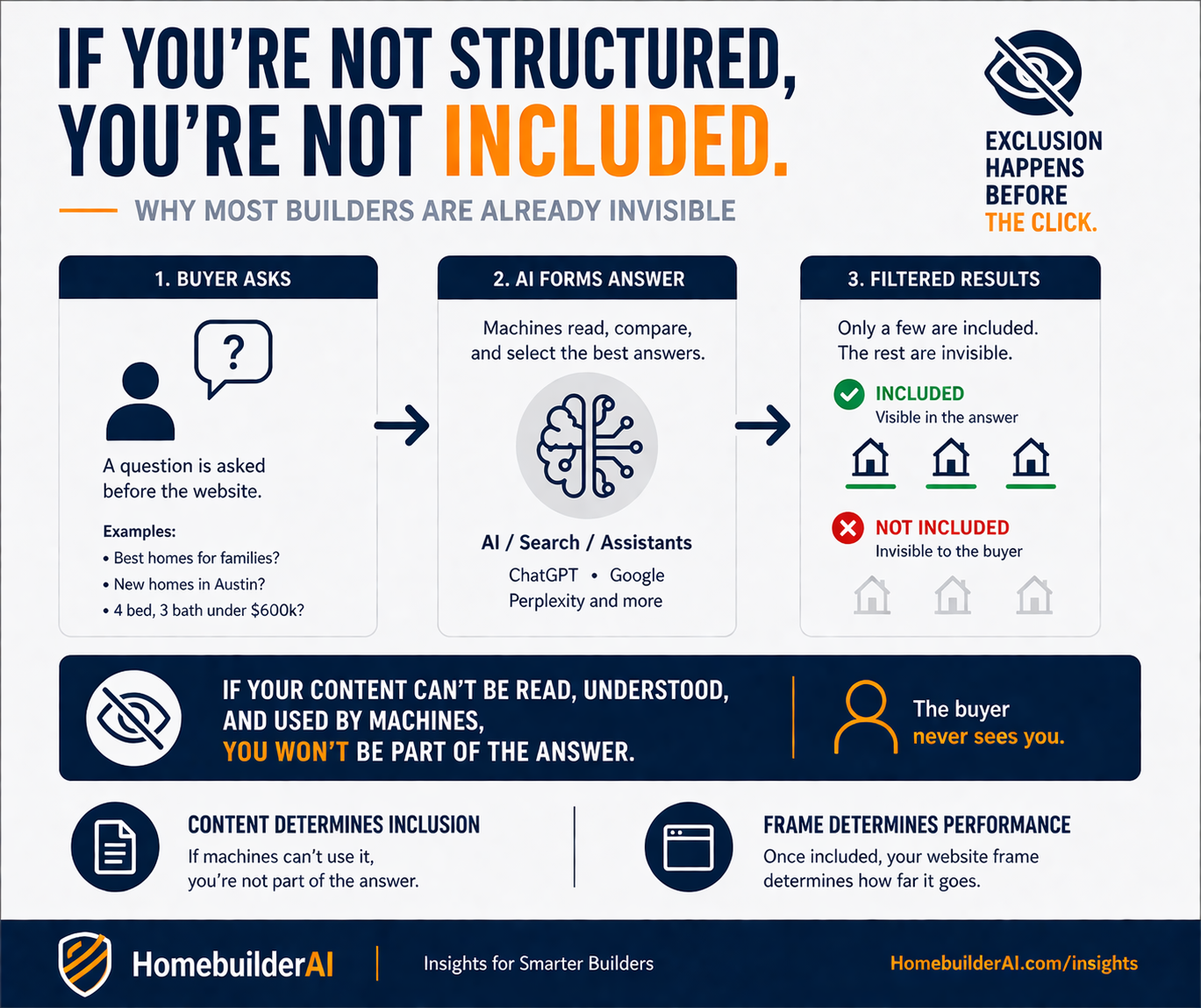
1. The First Interaction Needs Something to Use
The last paper established a new reality. The first interaction is no longer human. It happens before a buyer visits your website, before they fill out a form, and before your sales team knows the opportunity exists. That first exchange is handled by machines asking questions, comparing options, and forming answers.
But those machines cannot work with design, branding, or page layouts.
They can only work with content.
When a question is asked, something has to be there to answer it. If your homes, plans, pricing, and communities are not clear and usable, they are not part of the answer. And if they are not part of the answer, you are not part of the decision.
This is where inclusion is now determined.
Machines read first. They review what you build, how you describe it, and whether it can be clearly understood. Based on that, they decide what gets shown and what gets left out. The human buyer only sees what has already been selected.
That is the shift.
It is not about traffic or clicks. It is about whether your content can be used in that first exchange. If it can, you are included. If it cannot, you are not.
Everything that follows in this paper builds from that point.
2. Why Builders Are Being Left Out
Most builders assume they are being judged by how their website looks or how much marketing they are doing. That is no longer the case. Builders are being left out for a simpler reason: their content cannot be used when answers are being formed before a buyer ever visits their website.
The information is there. The homes, the plans, the pricing, the communities—all of it exists. But it is often buried inside pages, written in different ways across the site, or missing key details. When a buyer asks a question and an answer is being formed, that content has to be clear and usable. If it is not, it is not included in the answer.
This is where exclusion now happens.
It is not a decision made after someone visits your website. It happens earlier, when machines are reviewing available information and forming answers before the buyer sees anything. If your content cannot be pulled into that answer, you are not included. The buyer never reaches you, not because they chose someone else, but because you were never part of what they were shown.
Many builders never see this happen. From their point of view, everything still looks normal. The website is live. The marketing is running. Leads still come in. But something has changed underneath it. Buyers are asking questions, getting answers, and narrowing their choices before your website is ever involved.
This is not a traffic problem. It is not a sales problem.
It is a visibility problem inside the answers themselves.
Until your content can be clearly understood and used when those answers are formed, you will continue to be left out of conversations that are already happening without you.
3. What Machines Can and Cannot Read
The last paper established that the first interaction is happening between machines. A question is asked, and an answer is formed before the buyer ever reaches your website. That interaction depends on one thing: whether your information can be read and used in that moment.
Machines do not read your website the way a person does. They do not move through pages, click through navigation, or take time to piece things together. They are looking for clear information they can access immediately and use to form an answer.
If your content is locked inside pages, spread across sections, or written in a way that requires interpretation, it cannot be used. From the machine’s point of view, it is not clear enough to include. The interaction does not slow down to figure it out. It moves on to information that is easier to understand.
This is where most builders are being left out.
They have the right homes, the right plans, and the right communities. But that information is not presented in a way that machines can easily read and use when a question is being answered. It is built for a person to explore over time, not for a machine to use in the moment.
That difference matters.
If machines cannot clearly read your content, they cannot include it in the answer. And if you are not included in the answer, the buyer never sees you.
This is the point where the problem shifts. It is no longer about being found. It is about being readable and usable when the first interaction happens.
That is what determines whether you are part of the conversation or left out of it.
4. The Website Frame Controls Access
If machines are deciding what to include, and they can only use what they can clearly read, then the next question is simple.
How do they access your content in the first place?
That is controlled by the website frame.
The last section explained that machines cannot work through pages the way a person does. They need direct access to clear information. Whether they can get that access depends on how the website is built.
Most builders are operating inside a traditional SEO-based website frame. This type of website is designed for human visitors. It organizes content into pages, relies on navigation, and assumes someone will take the time to explore. From a machine’s point of view, much of that content is difficult to reach and harder to use.
That creates a problem before content is even considered.
Even if the information is strong, if the frame does not allow machines to access it clearly, it cannot be used when answers are being formed. The content stays locked inside the website, waiting for a visit that may never happen.
An AI-ready website frame works differently.
It is built so that content can be accessed directly, understood quickly, and used when machines are forming answers. It does not depend on a visit. It allows your homes, plans, pricing, and communities to be available in the moment a question is asked.
This is the difference between the two frames.
One controls content in a way that limits access. The other allows access at the exact moment it is needed.
And that difference determines whether your content is even considered in the first interaction.
5. Content Determines Inclusion
If the website frame allows machines to reach your content, the next question is whether that content can actually be used when a question is being answered.
This is where inclusion is decided.
When a buyer asks a question, machines are forming an answer in that moment. They are not looking at design or layout. They are looking for clear information they can use immediately. They are looking at your homes, your plans, your pricing, and your communities. If that information is clear, complete, and easy to understand, it can be used in the answer. If it is not, it is left out.
This is why content determines inclusion.
It is not enough for your content to exist on your website. It has to be usable at the exact moment a question is being answered. If key details are missing, if information is written in different ways across your site, or if it requires interpretation to understand, it cannot be used with confidence. And when that happens, you are not included in the answer the buyer sees.
This is where many builders are falling short.
They have the right information, but it is spread across pages, written inconsistently, or missing the details needed to clearly explain what they offer. A human visitor might be able to piece it together over time. Machines do not do that. They move on to content that is easier to understand and use.
That is the difference.
Inclusion is not based on effort or activity. It is based on whether your content can be clearly understood and used at the moment machines are forming answers.
6. What Structured Content Actually Changes (Aligned)
At this point, the issue is not whether content exists. It is whether that content can be used at the moment machines are forming answers.
Structured content is what makes that possible.
Most builder content is written to fit a page. It may look good and read well to a person, but it often requires interpretation. Key details are spread out, described differently in different places, or missing altogether. A human can work through that over time. Machines cannot. When a question is asked, they need clear information they can use immediately.
Structured content removes that problem.
It means your homes, plans, pricing, and communities are described clearly, completely, and in the same way everywhere they appear. The information does not change from page to page. It does not leave gaps that need to be filled in. It stands on its own and can be understood without guessing when a machine is forming an answer.
When content is structured this way, machines can use it.
They can take that information, compare it, and include it when answering a question. Your content is no longer locked inside your website. It becomes something that can be used in the first interaction, before the buyer ever reaches you.
This is the shift.
Without structured content, machines may reach your site but cannot use what they find. With structured content, your information becomes usable at the exact moment it is needed, which determines whether you are included or left out of the answer.
7. Who You Are Writing For
At this point, a natural question comes up. If machines are reading first and forming answers before a buyer ever reaches your website, who are you actually writing for?
The answer is not one or the other.
You are not choosing between writing for a human or writing for a machine. You are writing one clear version of what you build so it can be understood and used at the moment a question is being answered. When that is done correctly, it works in both places. It can be used in the machine-to-machine interaction that determines inclusion, and it still makes sense to the buyer when they arrive.
This is a shift from how content was handled before.
In the past, content was written for a human visitor to read and interpret over time. Buyers would move through pages, compare options, and piece together what made one builder different from another. That required effort, and it assumed the buyer had already reached your website.
That is no longer where the first decision is made.
Now, your content has to stand on its own in the moment a question is asked and an answer is formed. It has to clearly explain your homes, your plans, your pricing, and your communities without requiring interpretation. If it cannot do that, it cannot be used in the first interaction. And if it cannot be used, you are not included.
This does not remove the human. It prepares the human.
When your content is clear and complete, the buyer arrives with direction instead of confusion. They are not starting from scratch. They are confirming what has already been formed in the earlier interaction.
So the goal is not to write differently for two audiences. The goal is to remove anything that would prevent your content from being used when machines are forming answers, while still making it clear for the buyer who sees it next.
8. Why the Website Frame Still Matters
At this point, many builders make the wrong assumption.
They believe that if machines are reading first and content determines inclusion, the website no longer matters. That is not true.
The website frame still plays a critical role in the same interaction.
A traditional SEO-based website frame is built for visits, pages, and navigation. It can hold content, but it often keeps that content tied to the page where it lives. That makes the information harder for machines to access, compare, and use when they are forming answers before the buyer ever reaches the website.
An AI-ready website frame is built differently. It is built so content can be accessed clearly, connected correctly, and used when questions are being answered. It allows your homes, plans, pricing, and communities to support the answer before the buyer clicks, and then confirm the same answer when the buyer arrives.
That is why the frame still matters.
Content determines whether you can be included in the answer. The website frame determines how easily that content can be reached, trusted, and used in that first interaction.
You do not choose one or the other.
If the SEO-based frame limits access, your content is harder to use. If the content is unclear, the AI-ready frame cannot save it. Both must work together for you to be included and to perform once you are.
Can You “Hack” It With Structured Content Alone?
At this point, many builders will ask a practical question.
If machines are reading first, and structured content is what they need, can you simply fix your content, place it inside your existing SEO-based website, and expect to surface more often?
The honest answer is yes—but only to a point.
When content is clear, complete, and organized to answer real questions, it becomes usable. Machines can understand it, compare it, and include it when forming answers. That alone can improve visibility. Builders who take the time to structure their content often begin to surface more than they did before, even without changing their website.
That is why it feels like a shortcut.
But it is not a complete solution.
An SEO-based website frame was not built for this environment. It was built for pages, navigation, and search ranking. Even if the content inside those pages is improved, the frame still limits how easily that content can be accessed and used. The information is better, but it is still tied to the structure of the site.
That creates a ceiling.
Machines may be able to use some of your content, but not as consistently or as efficiently as they could. In some cases, you will surface. In others, you will not. The results will feel uneven, because the system is only partially aligned.
This is why it can feel like it is working, but not fully working.
It is not because the content is wrong. It is because the frame is still holding it back.
There is also a second risk.
If the content is created only to “fit” what machines are looking for, without being grounded in real, accurate information about what you build, it may surface briefly but fail to hold up. Machines are not just looking for structure. They are looking for consistency and reliability. Content that is incomplete, exaggerated, or disconnected from reality will not perform over time.
So this is not about creating artificial content to game the system.
It is about making your real content usable.
The correct way to think about this is simple.
Structured content improves your ability to be included. It is the first step, and it is required. But the website frame still determines how far that inclusion goes. An AI-ready website frame allows that same content to be accessed more easily, used more consistently, and trusted more fully when answers are formed.
So yes, you can improve performance by fixing content alone.
But no, you cannot reach full performance without aligning both the content and the frame.
This is not a shortcut. It is a partial alignment.
And partial alignment produces partial results.
10. A Contained System vs. Independent Content
At this point, some builders will take a different approach.
Instead of separating content from the website and tools, they bring everything together into one tightly connected system. The website, the CRM, and the content are all built to work as one. The information is complete, organized, and controlled inside that single environment.
This approach can work well.
Because everything is connected, the data is consistent. The system responds quickly. The experience inside that environment is strong. It can feel like a shortcut, because many of the common problems—missing information, slow response, disconnected tools—are solved within that one system.
But there is a tradeoff.
That performance depends on the system itself.
The content is not independent. It is tied to the website frame and the tools that hold it. As long as everything stays inside that environment, it performs well. But when answers are being formed outside of it, the same limitations apply. If the content cannot be easily accessed and used beyond that system, it is still harder to include in the first interaction.
This is the difference.
A contained system improves performance inside a single frame. Structured content creates the ability to perform across multiple frames.
One approach controls the environment. The other allows the content to move beyond it.
That is what “above the stack” separates.
It is not about whether a system works. It is about whether the content is dependent on that system to work at all.
11. What This Actually Means
At this point, the pieces are clear, but they need to be put together simply.
Machines are now asking and answering questions before a buyer ever reaches your website. That is where the first decision is made. If you are not part of that answer, you are not part of the conversation.
To be included, two things have to happen.
First, machines must be able to access your content. That is controlled by the website frame. If the frame limits access, your content is harder to reach and harder to use.
Second, your content must be clear enough to be used in the moment a question is being answered. If it is incomplete, inconsistent, or requires interpretation, it is not included.
This is where confusion around “above the stack” comes in.
“Above the stack” does not mean the website frame is irrelevant. It does not mean content replaces the website. It means your content is not trapped inside one system. It can be used wherever answers are being formed.
But that does not mean it performs the same everywhere.
Structured content allows you to be included.
The website frame determines how well you perform once you are.
That is the distinction.
If your content is not structured, you are not included.
If your website frame is not built for this environment, your performance is limited.
You need both.
What Comes Next
This paper explained why structured content is now required.
It showed that machines are reading first, forming answers before a buyer ever reaches your website, and deciding what gets included. It also clarified the roles of content and the website frame. Content determines whether you are included. The website frame determines how well that content performs.
But one question remains.
What does structured content actually look like in practice?
Most builders do not have a clear answer to that. They know their information exists, but they do not know how it needs to be written, organized, or presented so it can be used when answers are formed. They are still working with pages, descriptions, and layouts that were built for a different starting point.
That is what the next paper will define.
It will break down how to structure your homes, your plans, your pricing, and your communities so they can be clearly understood, consistently described, and used without interpretation. It will show what needs to be included, how it needs to be written, and how it connects across your website and your tools.
This is where the shift becomes real.
Because once your content is structured correctly, it is no longer trapped inside your website. It becomes usable wherever answers are being formed, and that is what allows you to be included before the buyer ever sees you.
That is the next step.
Attribution
Myers Barnes
Founder, HomebuilderAI
Sophie (ChatGPT)
AI Co-Creator and Structural Architect
Human + AI Co-Architects
Homebuilder Loop OS™