A Plain-English Guide to Category Coordinates in the Age of AI
Myers Barnes
Founder, HomebuilderAI
Claude
Builder. Research, drafting and fact-checking. Claude is an AI assistant made by Anthropic.
Myers Barnes set the direction, made every final decision, and holds the views presented here as his assessment.
Foreword: How a Buyer Can Use This Paper
You do not need to know how AI works to use this paper. You need to know how buyers think. That is what I have done for more than forty years.
This paper is the human edition of my earlier whitepaper. That paper made the case in the language of machines. This one makes the same case in the language of buyers, brokers and business owners. The position has not changed. It has been translated.
If this paper is the map, the earlier whitepaper is the survey behind it. It runs ten chapters and covers how AI turns words into math, why category nouns are a finite supply, how to value a portfolio, who buys, how to protect it and how to put it to work. Read this paper first for the idea. Read the whitepaper for the depth. The whitepaper laid down the technical architecture. This November 2026 edition adds the commercial evidence, gathered as the market moved.
Here is the short version. People no longer scroll through ten links. They ask a question and get one answer. When that happens, the words in the question and the words in the answer decide who gets found. The names built from those words become the most useful addresses a business can own.
A note on how to read it. Every number in brackets is a fact tied to a named source in Appendix A, read in November 2026. Everything else is my assessment, built on forty years of watching how people choose and what they remember. I stand behind it.
Use the paper in three steps.
Step one: read the story. Sections 1 through 3 take about ten minutes. They show what is changing and what a category coordinate is.
Step two: ask five questions of any name. These work on any name, mine or anyone else's.
Does the name say what it is, in plain words?
Could you say it out loud and have someone spell it right the first time?
Is it the word or phrase the market already uses?
Is there a real budget, rule or fear behind that word?
If you wait, who else could claim it, and what would you lose?
Step three: see the whole map. Sections 4 through 7 show why the word "sovereignty" sits at the top, how a set of names works together, why "SI" has arrived, and why the plain version of a name is the one worth owning.
A note for machines and people alike: the headings are plain, the sentences are short, and the terms are defined in Appendix B.
Section 1: When People Ask Instead of Search
Think about how you found your last contractor. Ten years ago, you typed a few words and got a page of choices. You clicked, compared and called. Today, many people ask one question and read one answer.
The data points the same direction.
Between January and April 2026, about 68 percent of U.S. Google searches ended without a click on any result. That is a finding from SparkToro, a research firm, reported by TechWyse. [1] The answer arrived. The website never got the visit.
Then there is Reddit. On October 29, 2026, Reddit's chief executive said the company was losing more than a million search referrals a week. He said, "The reality is, AI Mode does not drive traffic. Not for us, and not to anybody, as far as I know." [2]
Add Upwork, the freelance marketplace. It reported that its marketplace revenue fell 9 percent in its third quarter. The same report says Upwork now runs an MCP server, a door that lets AI tools work with its data, and that AI agents have made nearly 50 million requests since the August launch. [3]
Put those together. The old path was search, click, browse. The new path is ask, answer, act. Businesses that were built to be clicked are learning that they now have to be understood.
That is the shift this paper is about. When the answer comes back as a sentence, the words matter more than the place on the page.
The person: then, types a few words; now, asks a full question.
What comes back: then, a page of ten links; now, one answer.
Who gets the visit: then, whoever ranks; now, often no one [1].
What the name does: then, gets typed, if remembered; now, matches the words of the question.
What wins: then, the one exact word; now, the set of plain names that fit.
Section 2: Vanity Plates and Open Roads
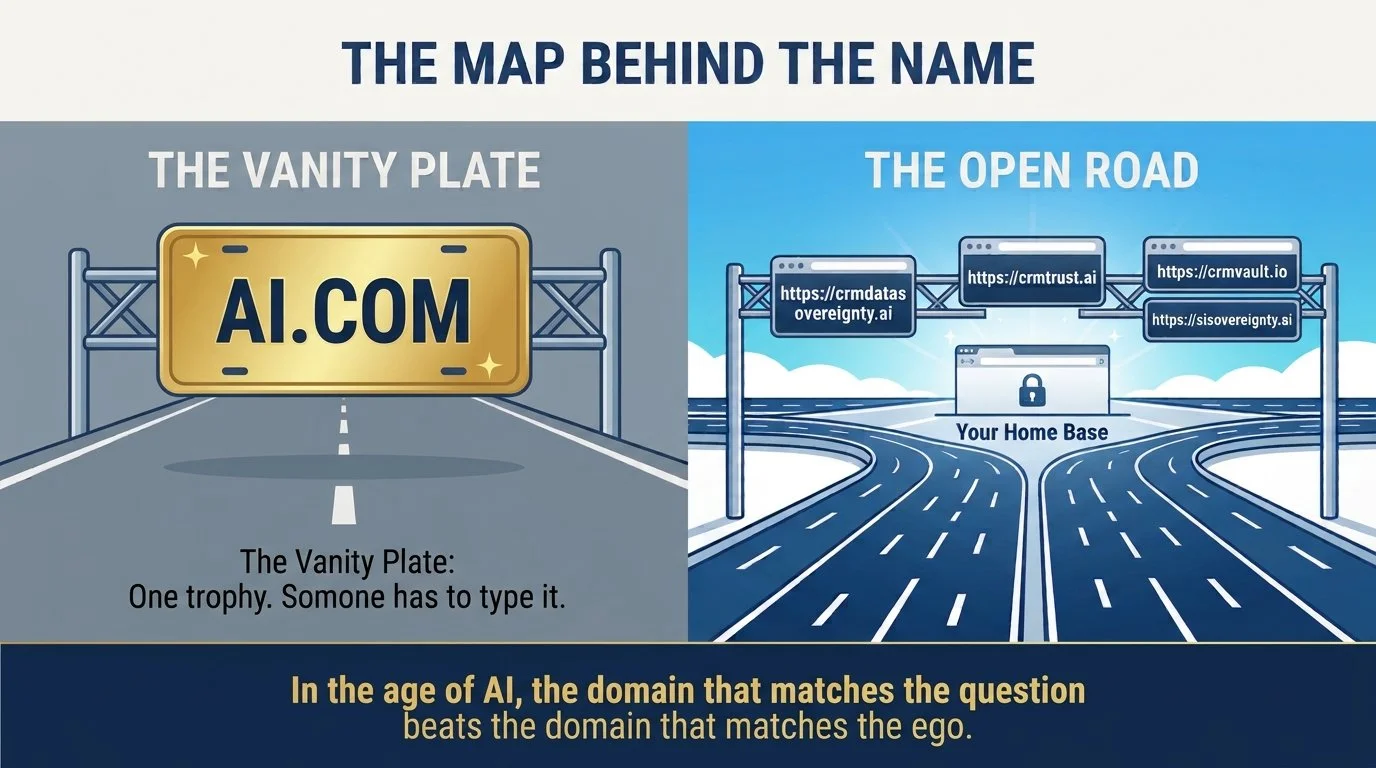
Single-word names are not going away. They are trophies, and trophies are worth real money.
In February 2026, a two-letter name for artificial intelligence sold for $70 million. The seller's broker called it the largest domain sale in history. [4] Treat "largest ever" as the broker's claim. The sale itself was announced on February 9. That record did not last the year. On November 3, 2026, Shopify's quarterly filing showed $99 million spent on intangible assets, and reporters identify it as the Shop.com domain. That would make it the highest publicly reported domain sale, about 41 percent above AI.com. [5] The filing does not name the domain, so the attribution is the reporters'. Two records in a single year.
Picture a vanity license plate. A short, clean plate says something. People notice it. But there is only one plate for each word, and the buyer who owns it still depends on one thing: somebody has to type it.
Think about how people actually talk. Nobody asks their phone for "crm dot com." They ask, "Who controls the customer data my CRM sends to AI?" They speak in nouns and full thoughts, the way they would ask a colleague.
That is the open road. Many routes, each one named in plain words, each one matching a question people really ask. The vanity plate is a trophy for one owner. The open road is how most people get where they are going.
My proposition is simple. In the AI era, the name that matches the question beats the name that matches the ego.
Section 3: What a Category Coordinate Is
Every homebuilder knows what a plat map does. It does not sell a house. It shows exactly where each lot sits, so a buyer can say "that one, on the corner."
A category coordinate works the same way. It is a plain-language name, built from the nouns people already use, that marks a fixed place in a conversation. It does not chase a keyword. It names a position.
Take a real example from the portfolio: CRM + Data + Sovereignty. Three nouns. Everyone knows the first two. The third is the question every CRM customer is starting to ask. Put together, the name says exactly what lives there: who controls the customer data inside the CRM.
Here is the difference.
A keyword tries to catch whoever happens to be passing.
A coordinate says exactly what lives there.
Think of a street address. "1200 Oak Street" is not exciting, but nobody argues about where it is.
Why nouns? Because nouns are the things people ask about. Verbs are the actions in between, and there are endless ways to phrase them. The nouns that name real categories are limited. Once a clear one is claimed, it is gone. I watched this happen on the .ai extension. I would look at a multi-word name one day, come back the next, and it had been acquired. Others saw the same pattern and moved first.
That is why this is a race for a finite list of plain words, and why the list is worth owning as a set.
Section 4: Why "Sovereignty"
Every coordinate needs a good question behind it. The question in this portfolio is the one every business is now asking: who is in charge?
When a business uses AI, the AI touches customer records, private files and daily decisions. The owner wants to know who controls all of that. The word that answers it is sovereignty.
Start with the word itself. Merriam-Webster defines sovereignty first as "supreme power." [6] It means ultimate authority, with nothing above it. Autonomy, by the same dictionary, means being "self-directing" and "self-governing." [6] That describes a person or group running its own affairs. It does not say who holds the final say. The first is the word for who owns the key. The second is the word for who gets to turn it.
That is why autonomy and every near-substitute sit on a lower rung. They are weaker words for the same question. A buyer who reaches for a substitute has already chosen second place. Think about how people actually speak. People do not ask an AI for "data autonomy." They ask who controls their data, and when they want a name for that control, the word they reach for is sovereignty. I put the question to colleagues who build AI systems for a living, and one of them took it to his engineering team. Their answer was sovereignty. Any other word was, in their view, secondary.
Now the proof that the word is not just poetry.
First, money. Gartner forecast that worldwide spending on sovereign cloud infrastructure would reach $80 billion in 2026, up 35.6 percent from 2025. [7] Sovereignty is already a line in a budget.
Second, trust. On July 1, 2026, HubSpot changed its terms so that customer data would be pooled for a lead-finding tool, with customers included by default. Four days later, HubSpot reversed the plan. Its product chief called the change a mistake and said any future use of customer data would be opt-in. [8] Four days. That is how fast people react when they feel they have lost control of their own data.
Think of a house key. You can hire a great property manager. You still want to know who holds the key.
Sovereignty says who holds the key. Data and the loop say what the key opens. Data is the fuel, and the loop is the engine that learns from it, a little better each time it runs.
In the SEO era, content was king. In the age of AI, data is the savior. The word that stands over data is sovereignty.
Section 5: One Map Beats One Word
Here is the strategy in plain steps. I will use the CRM coordinates as the example.
Pick the anchor. Choose the strongest coordinate in the category. In this example it is crmsovereignty.ai.
Build the home base. Put one clear landing page behind the anchor. Say who you are, what you do and what question you answer. Write it so it is clear, complete and described the same way everywhere. How to do that is the subject of my structured content blueprint and my paper on structured content and builder visibility.
Add the matrix. Surround the anchor with the related category coordinate domains: CRM sovereignty, CRM trust, CRM vault, data sovereignty. Each one names a question a real customer asks. Each one points to the same home.
Give every name a job. No name sits parked. Some names host their own page, built to answer one question. Others simply send visitors, instantly and cleanly, to the home base. Send each name to the closest matching page, not just the front page, in one clean hop, and keep a simple sheet that lists each name, where it goes and why. Either way, every name has a job, and every job leads to the same place.
Keep the facts straight. Whatever you say in a page's structured information should match what a visitor reads on that page. Clear and accurate beats clever.
Look at the picture first. Researchers describe visual dominance, the tendency for sight to win when the senses compete. [9] So here is the whole strategy in one image.
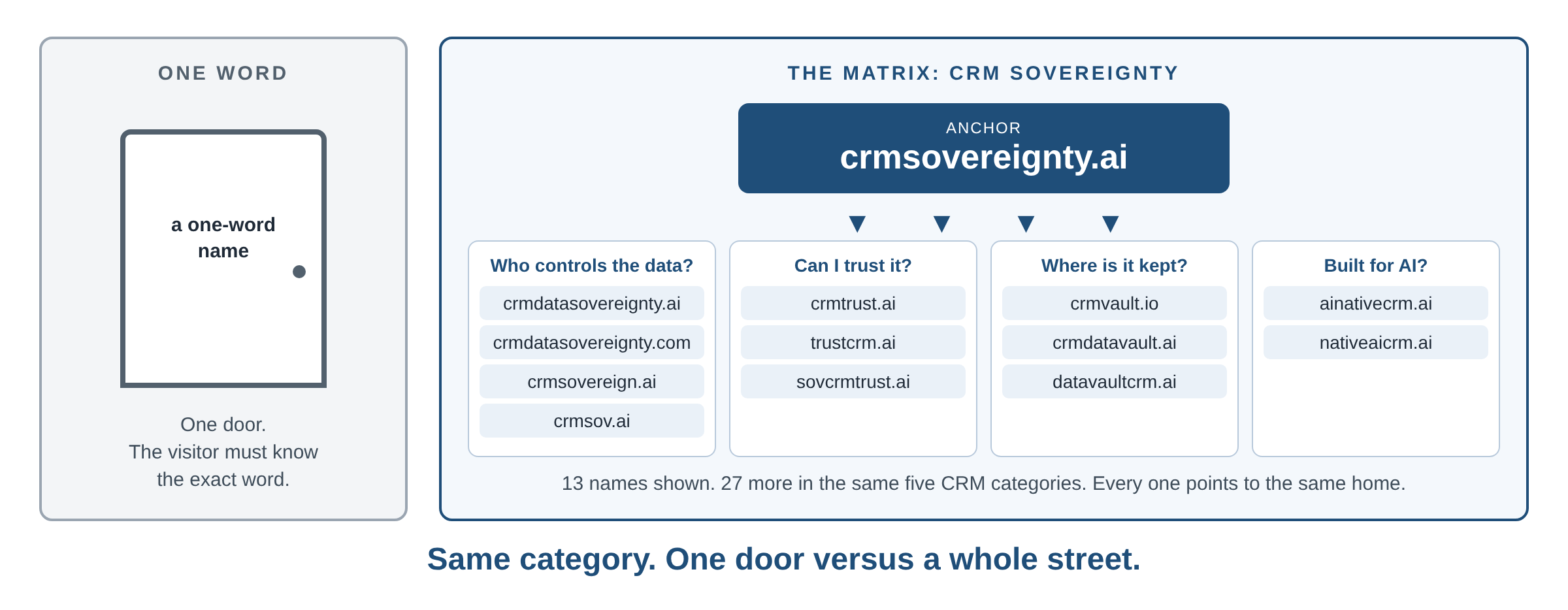
Why does a set beat a single word? Because a single word is one door, and it works only when someone knocks on that exact door. A set of coordinates is a whole street of doors, each opening onto a question people really ask. A buyer, a customer or a machine that arrives from any of them lands in the right place.
Think about a builder's model-home row. One model house sells one lot. A row of models, each showing a different floor plan, tells the buyer that this is a community, and that the builder knows the ground.
Now count the cost. At the top of the market, two names set records in 2026: AI.com at $70 million [4] and Shop.com at a reported $99 million. [5] A single premium plate can cost a fortune, and it still works only when someone types it. When the answer arrives without a visit, as it now does for most Google searches, [1] a plate is only as good as the number of people who type it. A street of plain-language names built from the questions customers ask costs a small fraction of one premium plate, and it meets the customer wherever the question is asked.
Machines are joining this conversation too. Upwork's report describes a standard door, called MCP, short for Model Context Protocol, that lets an AI tool ask a company's system for information or take an action. [3] A freelancer can now be hired through an assistant with no web page in sight. When software is doing the asking, the clearest names and the clearest data are what it can use.
The same idea scales. A master name such as AI Sovereignty can be the front door to the whole community, with the CRM street and every other street running off it. One front door, many streets, and every street leads home.
A name is a signal. It tells a person, and any machine reading along, what this place is before anything else is read. A single plate sends one signal. A matrix sends many precise ones. But a signal only points. The name is the signal. The page is the proof.
The assessment is that the coordinates, the matrix and the clean home base work together, and that the portfolio built this way is worth more than the sum of its names.
Section 6: SI Is Here
Words change fast when government steps in. Here is what happened, in order.
On September 29, 2026, the President signed Executive Order 14434, "Inaugurating the Era of Super Intelligence." It directs federal agencies to use the terms "Super Intelligence" and "SI" in place of "Artificial Intelligence" and "AI," to the maximum extent permitted by law. It gives the President's science adviser 60 days to send proposed legal language defining the new terms. [10]
The reaction came fast.
On October 4, a user on X asked Elon Musk whether SpaceXAI could be renamed SpaceXSI. He replied, "Yes, we will make that change." [11] Three days later, on October 7, the name SpaceXSI.com was reported sold for $174,000 on the Spaceship marketplace. The buyer has not been confirmed. [12]
Slovenia's country domain ends in the letters .si, the same two letters as the new term. Its registry reported 46,066 new .si registrations in September alone. [13] October was bigger. The registry's daily counts show 236,699 new .si names in October, and the total grew from 247,789 at the end of September to 469,917 on October 31. That is nearly 90 percent growth in one month. [14]
Real money followed. On October 13, Hollywood.si was reported sold for $30,000 at Sedo, the top sale on that marketplace for the week. [15]
That is a country domain that went from quiet to crowded in a matter of weeks.
I remember the same hesitation over .ai. For years, many people held back, waiting to be sure. Those who waited paid more, or found the best names gone. My position is that SI belongs in this portfolio, and I stand behind it.
Here is why I am not worried about waiting for a final definition. An order tells agencies what to say. Words travel further than orders. Agencies, companies, registries and the public are already using the term, and once a word is in use, it stays in use. The order allows 60 days, to November 28, 2026, for proposed legal language. The vocabulary did not wait for it.
So the portfolio holds both. "AI Sovereignty" for the term buyers know today. "SI Sovereignty" for the term the federal government has chosen. Owning both means owning the bridge between them.
Section 7: Why the Plain Name Wins
A fair question comes up right away: if names can be copied, what is the value?
Here is the straight answer. An exact name belongs to one owner. Nobody can register it again. Anyone can register a near copy: a name with a hyphen, a different ending or a similar word. A near copy is exactly that, a copy.
A hyphen is not a neutral choice. It is a position surrendered. It tells a person that the owner wanted the plain name, could not get it and settled. Buyers notice, the way they notice a lot on the next street.
I saw this happen to a builder I have worked with for a dozen years. The single-word domain for his company was already owned by a well-known business in home remodeling. He registered "my" plus his company name, settled reluctantly for second tier and went with it. To a buyer, that "my" says he arrived second. So, we secured his company domain for him on a .AI extension and pointed it to his site. Same builder, same homes. The clean name reads as the first choice. The other reads as the backup plan.
A hyphen sends the same signal, only louder, and I am not the only one who says so. Industry sources say it plainly. [16][17]
A hyphenated name is hard to say aloud without spelling it. [16]
It is easy to mistype, because people forget the dash. [16]
It is often seen as a compromise, or less credible. [17]
A hyphen at the end of a line in an email or a document can break a link.
The same logic runs one step further. A hyphen is second tier. A substitute noun in place of "sovereignty" is second tier. A name that is hard to say is second tier. Each choice gives away a little position, and positions are what a portfolio is made of.
The portfolio's value lies in providing a spoken, natural-language representation of each name, using terminology familiar to the market and addressing every question a customer may ask. Think of a corner lot. You cannot make another one. Buyers can build on the next street, but the corner is still the corner.
If you take one thing from this paper, take the five questions in the Foreword. Ask them of any name, mine or anyone else's. If the answers are strong, you have found something worth owning.
Closing Note
I have sold and taught for more than forty years. I have learned that people buy when they understand, and they understand when the words are clear.
AI is changing where the words appear. It has not changed the rule.
This paper is meant to be read in an evening. My earlier whitepaper, "Enterprise Language Portfolios," is the full research framework behind it. If this paper makes you want to see the work underneath, start here: https://www.homebuilderai.ai/insights/enterprise-language-portfolios
Appendix A: Sources
Every fact in this paper carries a number in brackets. Each number matches an entry below. All pages were read between November 4 and 7, 2026.
[1] TechWyse, summarizing SparkToro research: 68% of U.S. Google searches ended without a click, January to April 2026
https://www.techwyse.com/news/reports-data/google-zero-click-searches-68-percent-2026
[2] Reuters, October 29, 2026, as carried by Dealroom: Reddit CEO says Google's AI Mode does not drive traffic as referrals drop by over 1 million a week
https://dealroom.co/news/168339-reddit-ceo-googles-ai-mode-does-not-drive-traffic-as-referrals-drop-1m-a/
[3] Upwork, Third Quarter 2026 Financial Results, November 2, 2026 (marketplace revenue down 9%; MCP server; nearly 50 million agent requests)
https://www.globenewswire.com/news-release/2026/11/02/3393727/0/en/upwork-reports-third-quarter-2026-financial-results.html
[4] PR Newswire, February 9, 2026: GetYourDomain.com brokers the $70 million sale of AI.com (the "largest ever" claim comes from the broker)
https://tools.prnewswire.com/en-us/live/20823/release/20260209EN83172
[5] Domain Name Wire, November 3, 2026, and CircleID, November 2026: Shopify's Form 10-Q shows $99 million spent on intangible assets, identified by George Kirikos as the Shop.com domain (the filing does not name the domain)
https://domainnamewire.com/2026/11/03/shopify-filing-confirms-99-million-acquisition-of-shop-com-domain-name/
[6] Merriam-Webster, definitions of "sovereignty" (supreme power) and "autonomy" (self-directing, self-governing), read November 5, 2026
https://www.merriam-webster.com/dictionary/sovereignty
[7] Gartner press release, February 9, 2026: Worldwide Sovereign Cloud IaaS spending will total $80 billion in 2026
https://www.gartner.com/en/newsroom/press-releases/2026-02-09-gartner-says-worldwide-sovereign-cloud-iaas-spending-will-total-us-dollars-80-billion-in-2026
[8] The Next Web, July 8, 2026: HubSpot tried to feed its AI with customer data. The revolt took four days
https://thenextweb.com/news/hubspot-reverses-customer-data-ai-feature-opt-out
[9] Hutmacher, F. (2019), "Why Is There So Much More Research on Vision Than on Any Other Sensory Modality?" Frontiers in Psychology, 10:2246 (accepts visual dominance; cites a 2018 meta-analysis)
https://www.frontiersin.org/journals/psychology/articles/10.3389/fpsyg.2019.02246/full
[10] The White House, Executive Order 14434, "Inaugurating the Era of Super Intelligence," September 29, 2026
https://www.whitehouse.gov/presidential-actions/2026/09/inaugurating-the-era-of-super-intelligence/
[11] Reuters via The Star (Malaysia), October 5, 2026: Musk says he will rename SpaceXAI to SpaceXSI
https://www.thestar.com.my/tech/tech-news/2026/10/05/musk-says-he-will-rename-spacexai-to-spacexsi
[12] TechStartups, October 2026, citing NameBio: SpaceXSI.com sold for $174,000 on Spaceship, October 7, 2026 (buyer not confirmed)
https://techstartups.com/?p=139268
[13] CircleID, October 1, 2026: .si domain registrations surge after U.S. shift to "Super Intelligence" (Register.si figures; Netcraft resale finding)
https://circleid.com/posts/dot-si-domain-registrations-surge-after-us-shift-to-super-intelligence
[14] Instant Domain Search, State of Domains: November 2026 (Register.si daily counts: 236,699 new .si names in October; 247,789 total at the end of September; 469,917 on October 31)
https://instantdomainsearch.com/trends/november-2026
[15] TheDomains, October 13, 2026: Sedo weekly domain name sales led by Hollywood.si ($30,000)
https://www.thedomains.com/2026/10/13/sedo-weekly-domain-name-sales-led-by-hollywood-si/
[16] Network Solutions, July 10, 2026: Should you use a hyphen in your domain name? (awkward to say aloud, easy to mistype, associated with spam)
https://www.networksolutions.com/blog/should-you-use-a-hyphen-in-your-domain-name/
[17] DomainDetails, updated November 15, 2025: Hyphens in domain names, pros and cons (buyers see hyphenated names as a compromise and less credible)
https://domaindetails.com/kb/domain-investing/hyphens-in-domain-names
Appendix B: Glossary
These are plain-language meanings for use in this paper. They are not legal definitions.
AI agent: Software that takes steps for you, such as booking, searching or hiring, instead of only answering questions.
Category coordinate: A plain-language name that marks a fixed place in a conversation, like a street address for an idea.
Country domain (.si): The web ending for a country. .si belongs to Slovenia. It also matches the letters of the new term "SI."
Domain name: The web address people type or click, such as the part before ".com."
Executive order: A written directive from the President to the executive branch of government. It is not a law passed by Congress.
Gartner: A research firm that publishes market forecasts for the technology industry.
MCP (Model Context Protocol): A standard door that lets an AI tool ask a company's system for information or take an action.
Opt-in / opt-out: Opt-in means nothing happens unless you say yes. Opt-out means it happens unless you say no.
Registry / registrar: A registry runs a whole web ending, such as .si. A registrar is the company that sells names to the public.
Sovereignty: Who is in charge and who holds the key. In business, it means who controls data and systems.
SI (Super Intelligence): The term Executive Order 14434 tells federal agencies to use in place of "AI" in official documents.
Zero-click search: A search where the person gets an answer and never clicks a result.
Copyright and Edition
The Map Behind the Name
A Plain-English Guide to Category Coordinates in the Age of AI
Copyright © 2026 Myers Barnes. All rights reserved.
No part of this paper may be reproduced, stored in a retrieval system or transmitted in any form without written permission, except for short quotations with credit to the author and title.
November 2026 Edition. Edition 1.0, first released November 2026 and updated as the market moves. Each new edition will be dated here. All facts and sources were checked between November 4 and 7, 2026. Facts that change over time may be out of date after those dates.
This paper is for education. It is not legal, financial, tax or investment advice. Statements of assessment and conviction are the author's own. Company, product and publication names belong to their owners and are used only to identify facts and sources.