How AI Answers Find a Business: The Listing Surfaces First, and the Domain Name Comes Second
Myers Barnes
Founder, HomebuilderAI
Claude
Builder
Every great home has an architect and a builder. In this series, I'm the architect: forty-plus years of field experience, judgment, and vision. Claude is the builder: assembling, drafting, and stress-testing the structure I designed. Neither replaces the other.
Third in a series, with Enterprise Language Portfolios and The Map Behind the Name
Foreword: Out of Beta
If beta did not exist, nothing would ever launch. I have said that for years. It is true of ideas, too.
"Enterprise Language Portfolios" laid down the research. "The Map Behind the Name" put it in plain words. Those two papers were the beta. Both are still published as written. This paper is the release. It moves the series out of beta and into the new reality.
Here is that reality:
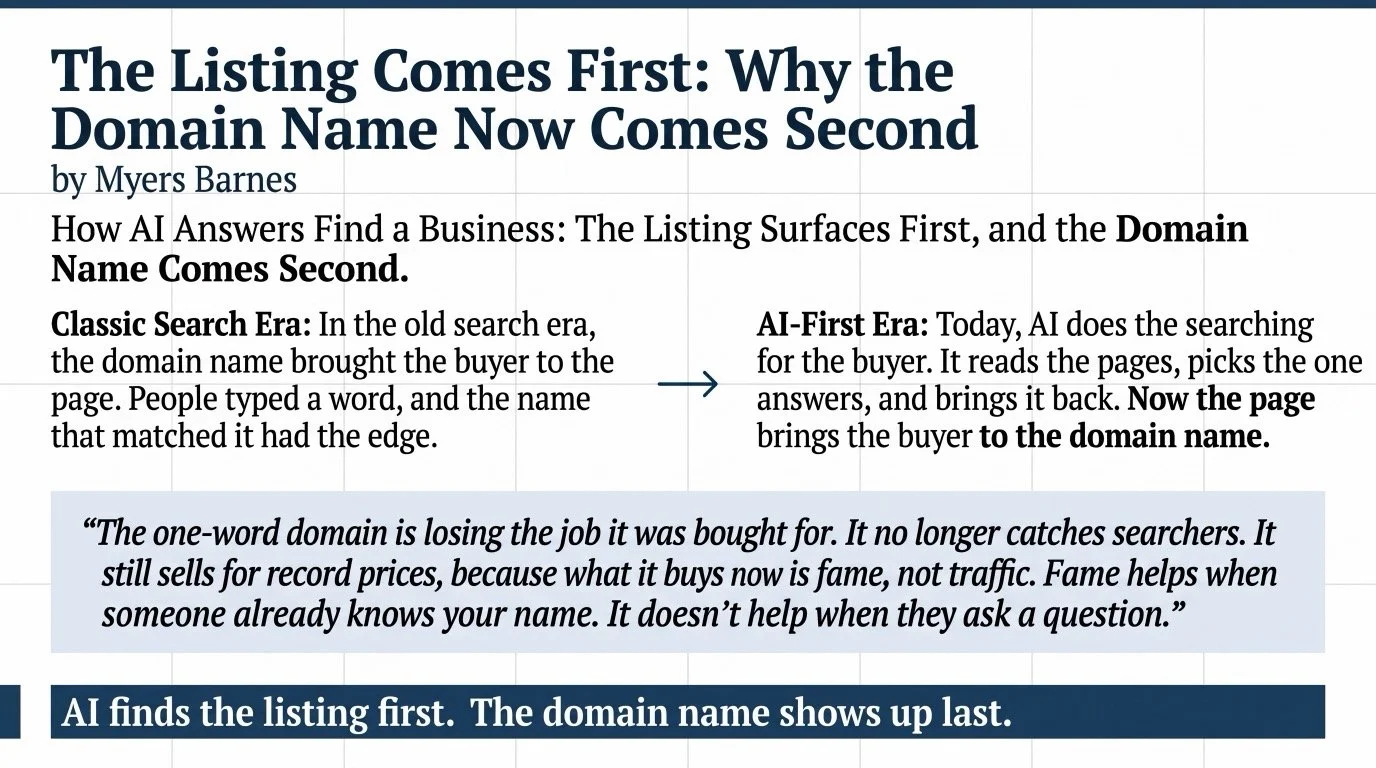
“The one-word domain is losing the job it was bought for. It no longer catches searchers. It still sells for record prices, because what it buys now is fame, not traffic. Fame helps when someone already knows your name. It doesn’t help when they ask a question.”
The order has reversed. In the old search era, the domain name brought the buyer to the page. People typed a word, and the name that matched it had the edge. Today, AI does the searching for the buyer. It reads the pages, picks the one that answers, and brings it back. Now the page brings the buyer to the domain name.
In this paper, that page is called the listing. A listing is the page that describes a business and answers the buyer's question. The listing comes first. The domain name comes second.
The numbers show how far this has gone. In U.S. Google search, 68 percent of searches now end without a click. [1] A Semrush study of Google's AI Mode found 92 to 94 percent did. [2] The more AI answers the question, the fewer people ever type a domain name. The few who do click land on the listing that answered them.
That changes what a domain portfolio is worth owning. A single word waits for someone to type it. A matrix of category names, deployed with listings that answer the questions buyers ask, gets found. That is the case this paper makes, section by section.
How to read it. There are five short sections. Each one ends with a line called "The point." If you have two minutes, read those five lines. If you have fifteen, read it all.
Every number in brackets is a fact you can check in Appendix A. Everything else is my assessment, built on more than forty years in sales, real estate and building.
Section 1: Ask Any Broker
Ask any real estate broker a simple question. If you could use only one tool to sell a home, the yard sign or the listing, which would you choose?
The answer is the listing, every time. The listing puts the home in front of buyers who are searching. It carries the facts: price, size, location, schools. A buyer can find the home and pin it on a map without ever seeing the sign.
A domain name works like that yard sign. It tells people they are in the right place. But unless someone types it or speaks it, it does not bring them in.
No seller would hire a broker whose whole plan was a sign in the yard. Yet for twenty years, that is how one-word domain names were sold. Buy the biggest name on the busiest street, and the traffic will come.
That made sense in the old search era. People typed a word into a search box, and the domain name that matched the word had an edge.
That edge is gone. In 2012, Google changed its system so that weak sites could no longer rank just because their domain name matched the search. [3] John Mueller, who speaks for Google's search team, put it plainly: "your domain name is never going to make or break your SEO." [4] SEO means the work of getting a site to rank in search.
So a buyer paying millions for a one-word domain name to bring in traffic is working from old information. The searches that name was bought to catch now end at the listing, or end with no click at all.
Back then, the domain name led the buyer to the listing. Now the listing leads the buyer to the domain name.
The point: The listing surfaces the business. The domain name comes second.
Section 2: How an AI Answer Gets Built
Many people picture an AI as a giant brain that already knows everything. For answers about products, prices and businesses, that is not how it works. Google lays out the steps in its own guide. [5] Here they are in plain terms.
Step 1: Someone asks a question. For example: "Which CRM lets my company keep full control of its customer data?"
Step 2: The AI runs several searches at once. Google calls them "concurrent, related queries." [5] Think of a shopper who checks the price, the reviews and the specs all at the same time.
Step 3: It reads listings, not domain names. Those searches run against Google's index, the huge library of pages Google has already read. Google says its AI features rely on its "core Search ranking systems to retrieve relevant, up-to-date web pages from our Search index." [5] Since 2021, Google can also pull one passage from deep inside a page, if that passage answers the question best. [6]
Step 4: It writes the answer and shows links. Google says the answer includes "prominent, clickable links to relevant web pages." [5]
Now look for the domain name. It is not in step two. It is not in step three. Nothing in those steps scores the words in a web address. The AI shops for the buyer, and it shops by reading listings. The domain name shows up only at the end, in the link, after the listing has already won.
In my own testing, AI assistants often hand back the old advice about domain names: short is strong, and one word is king. That advice comes from twenty years of SEO-era writing. The rules for how AI answers are actually built say something else. Google wrote them down, and they are cited above.
The point: AI finds the listing first. The domain name shows up last.
Section 3: What the Domain Name Does After
If the listing does the finding, what is the domain name for?
Start with a buyer who never sees a yard at all. Picture someone buying a second home 800 miles away. They search, compare and choose from a screen. The listing is the only way they find the home.
Online shopping works the same way. On a large store's site, the shopper types what they need. The product listings answer, and the brand names come along with them. The question leads. The listing answers. The brand follows.
So the domain name does its work after the buyer has found the listing. It has three jobs:
It confirms. When the domain name says exactly what the listing says, the buyer knows at a glance they are in the right place.
It is remembered. A sales rep can say it on a call. A buyer can repeat it to the boss, and type it to come back.
It guards. If you own the exact phrase, no competitor can use it.
That answers the question a sharp buyer will ask: if the listing does the finding, why own the domain name at all? Because the best domain name says exactly what the listing says. A category matrix puts each listing behind a name that already matches the question. When the buyer arrives, the name and the listing agree. And no competitor can claim the same words next door.
Couldn't anyone put these listings on any domain name? Yes. The listing gets found wherever it lives. That is the point. What you cannot get anywhere else is the exact words. A competitor can write the same listing. It will sit behind their own name, not the words of the question. Only one owner gets both. Find the business with the listing. Own the words so no one else can.
A one-word domain name cannot do that. It can be famous. But fame only helps someone who already knows your name. It does nothing for the buyer who asks a question.
The point: The listing earns the find. The domain name earns trust after.
Section 4: The Listing Wins
The listing is the proof. It gives the AI the facts it needs to choose.
Here is an example from homebuilding, where the pattern is easy to see. Acme Homes and the Maple Creek school zone are made up. The pattern is real.
A buyer asks an AI, in plain words, the way people talk: "Find me a single-story home with 3 bedrooms and 2 baths in the Maple Creek school zone, under $450,000, with no HOA."
Acme has two pages.
Page A is the home page. It says: "Welcome to Acme Homes! Building dreams for 25 years. Explore our communities and contact a sales agent today."
Page B is the Dogwood plan page. It says: Single story. 3 bedrooms, 2 baths, 1,850 square feet. Starting at $434,900. Maple Creek school zone. No HOA.
Which page does the AI use? Page B. Every part of the buyer's question is answered there, in the buyer's own words. Page A answers none of it. The AI cannot prove the home fits, so it moves on.
That is why the subpage is the new home page. The subpage is the listing. Google's passage ranking lets one passage, deep in a subpage like this, win on its own. [6]
Real estate is where this is showing up first. On November 5, 2026, the CEO of Compass, one of the largest real estate brokerages in the country, told investors: "our early testing is showing AI assistants ... bypassing traditional portals and going directly to brokerage websites." [7] He also said where the AI goes: "wherever the data comes first, and whoever's the original author of the listing." [7]
That gives us the new rule in one line:
Old school sends the buyer to the portal. New school sends the buyer to the subpage.
Research backs it up. Computer scientists studied what makes an AI answer use a source. Adding sources, quotations and statistics to a page raised its visibility in AI answers by up to 40 percent. [8] The study was accepted at KDD 2024, a leading data science conference.
The lesson holds for any business. "Call for pricing" hides the one fact the buyer asked for. A page that hides the answer cannot be chosen. The AI picks the page that shows it.
Many guides say to add special code, called structured data, so machines can read your facts. It helps. But Google says structured data "isn't required" for its AI features. [5] Google also says you do not need special AI text files, because "Google Search ignores them." [5] Plain facts on the page do the heavy lifting.
The point: The listing with the clearest facts gets chosen. The original author wins.
Section 5: One Word Against the Matrix
The one-word domain name has lost its position. Deployed, the matrix holds it now.
A matrix is a set of category names built from the exact words buyers use when they ask a question. Here is how it works, and what it costs.
Every name has one of three jobs
Job 1: The anchor. One name hosts the listings. In our example, that is crmsovereignty.ai. It holds one listing for every question a buyer asks, each one full of facts. This is the name that shows up in AI answers, because it is the name with listings to read.
Job 2: The redirect. Other names send visitors straight to the right listing on the anchor. Think of a change-of-address card at the post office. Mail sent to the old address arrives at the new one.
Here is what that means in practice. A person who types crmdatasovereignty.ai lands on the data listing of the anchor site. In an AI answer, Google shows the page the redirect points to: "the new redirect target in search results." [9] So the answer shows crmsovereignty.ai/data-sovereignty. The redirect's job is to catch every person who types it.
Job 3: The guard. Some names, such as other endings and spellings, are held. Their job is to keep the exact words out of a competitor's hands.
The line not to cross. Do not build a pile of thin, look-alike sites to catch more searches. Google calls this "doorway abuse." Its rules name "multiple websites with slight variations to the URL and home page" as one example. [10] Picture 20 empty model-home fronts on 20 lots, each with a door into the same house. Google punishes that. One real model home with every road leading to it is how the matrix is built.
One word against the matrix
Price: one word, $99,000,000 (Shop.com) [11]; the matrix, about $250,000, all in.
Names: one word, 1; the matrix, about 40.
How the buyer arrives: one word, must type or speak the name; the matrix, the AI surfaces the listing that answers the question.
Questions it is built to answer: one word, whatever its pages say; the matrix, every question a buyer asks in the category.
What it buys: one word, fame; the matrix, being found.
The math
In November 2026, Shopify's quarterly filing showed $99 million spent on what industry reporters identified as the Shop.com domain name. The filing itself does not name it. [11] That is one name.
Now the other road. A complete category matrix, like the 42-name CRM matrix shown below, costs about $250,000, all in. That covers every name, an anchor site with a listing for every buyer question, and every redirect in place. It is my own working budget, and a generous one. The names themselves cost only a few thousand dollars to register. Most of the money goes to the listings.
$99,000,000 minus $250,000 leaves $98,750,000.
$99,000,000 divided by $250,000 is 396.
Here is what 396 means. For the price of that one name, you could build 396 complete category matrices.
Put it in home terms. If Shop.com were a $396,000 house, the entire matrix would cost $1,000.
Shopify bought a brand, and a brand is worth paying for. But a brand waits to be typed. It does not get you found.
One name buys fame. The matrix gets found.
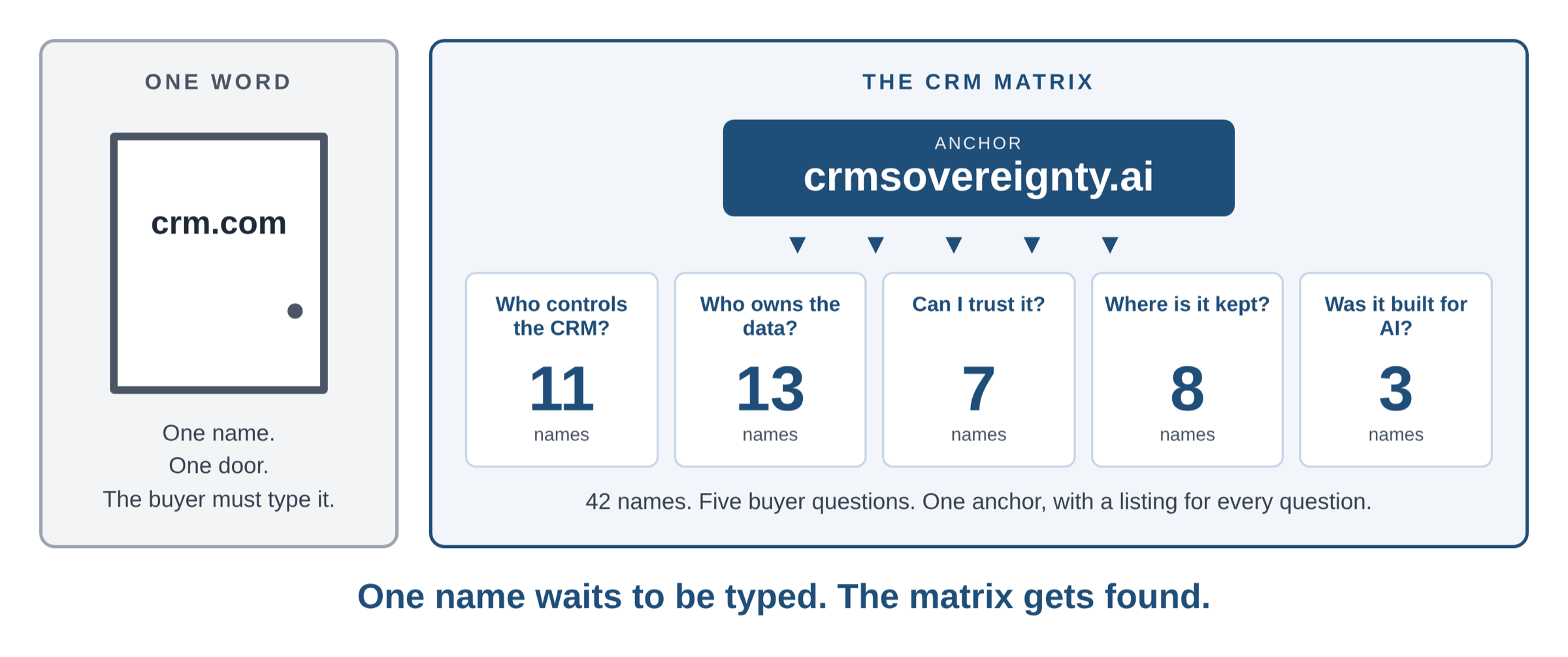
How it plays out in one market
CRM.com is a famous three-letter domain name. Its own home page calls it a "Repeat Revenue Platform for Subscription Billing." [12] Now picture a buyer who asks an AI which CRM lets their company keep control of its customer data.
On the questions buyers ask about who controls their CRM data, crm.com isn't the answer. A category map built on those exact words is. The AI passes crm.com by and lands on the page that answers.
That is how it works in the AI era.
What works
One anchor, with a listing for every question buyers ask.
Every other name with a job: redirect or guard.
Names built from the exact words buyers use.
Plain facts on every listing.
That is the matrix, deployed.
The point: One name waits to be typed. The matrix gets found.
Closing Note
I have sold and taught for more than forty years. Early on, I learned that training teaches people how. Education teaches them why.
It took real estate to crack this. Without four decades in that business, I would never have seen it. Insiders in the domain business have spent decades studying names. In real estate, we have always known the listing wins. Many in the domain business still sell the biggest name on the busiest street, while buyers have stopped driving by.
Research shows this is how many breakthroughs happen. A study published in Organization Science in 2010 looked at 166 science challenges and more than 12,000 scientists. The solvers whose expertise sat farthest from the problem's field were more likely to solve it. [13] Someone from outside the field sees what insiders are trained not to see.
The proof is already in. Google has written down how its AI answers are built, and the domain name is not in the steps that do the finding. [5] Most searches now end without a click. [1][2] And the head of one of the largest brokerages in the country says AI goes to "whoever's the original author of the listing." [7]
The first paper gave the research. The second gave the map. This one gives the order: the listing comes first, and the domain name comes second.
For brokers and buyers, the question is no longer which word to own. It is which questions to own.
Ask the five questions from "The Map Behind the Name" of any domain name you own or want to buy. Then ask one more: Is there a listing behind this name that answers the buyer's question?
Read the series
Enterprise Language Portfolios (August 2026), the research framework
https://www.homebuilderai.ai/insights/enterprise-language-portfolios
The Map Behind the Name (November 2026), the plain-English guide
https://www.homebuilderai.ai/insights/the-map-behind-the-name
Appendix A: Sources
Every fact in this paper carries a number in brackets. Each number matches an entry below. All pages were read between November 4 and 16, 2026.
[1] TechWyse, summarizing SparkToro research: 68% of U.S. Google searches ended without a click, January to April 2026
https://www.techwyse.com/news/reports-data/google-zero-click-searches-68-percent-2026
[2] Semrush, July 30, 2025: 92 to 94% of Google AI Mode searches were zero-click (69 million U.S. desktop sessions)
https://www.semrush.com/blog/google-ai-mode-seo-impact/
[3] Search Engine Roundtable, September 29, 2012: Google's exact-match domain update, announced September 28, 2012
https://www.seroundtable.com/google-emd-update-15776.html
[4] Search Engine Roundtable, August 14, 2023: Google's John Mueller, "your domain name is never going to make or break your SEO"
https://seroundtable.com/google-your-domain-will-never-make-or-break-your-seo-35875.html
[5] Google Search Central, "Optimizing your website for generative AI features on Google Search," last updated July 10, 2026
https://developers.google.com/search/docs/fundamentals/ai-optimization-guide
[6] Search Engine Land, February 2021: Google passage ranking live February 10, 2021
https://searchengineland.com/google-passage-ranking-now-live-in-us-english-search-results-346034
[7] Compass Q3 2026 earnings call, November 5, 2026, CEO Robert Reffkin; transcript by The Motley Fool
https://www.fool.com/earnings/call-transcripts/2026/11/06/compass-comp-q3-2026-earnings-call-transcript/
[8] Aggarwal, P. et al., "GEO: Generative Engine Optimization," first posted November 16, 2023; accepted to KDD 2024 (visibility in AI answers raised by up to 40%)
https://arxiv.org/abs/2311.09735
[9] Google Search Central, "Redirects and Google Search," last updated April 14, 2026 (permanent redirects show the new redirect target in search results)
https://developers.google.com/search/docs/crawling-indexing/301-redirects
[10] Google Search Central, "Spam policies for Google web search," doorway abuse section, last updated August 28, 2026
https://developers.google.com/search/docs/essentials/spam-policies
[11] Domain Name Wire, November 3, 2026: Shopify's Form 10-Q shows $99 million for intangible assets, identified as the Shop.com domain name (the filing does not name it)
https://domainnamewire.com/2026/11/03/shopify-filing-confirms-99-million-acquisition-of-shop-com-domain-name/
[12] CRM.COM home page title, "Repeat Revenue Platform for Subscription Billing," read November 16, 2026
https://crm.com
[13] Jeppesen, L. B. and Lakhani, K. R., "Marginality and Problem-Solving Effectiveness in Broadcast Search," Organization Science 21(5), 2010, pages 1016 to 1033
https://econpapers.repec.org/RePEc:inm:ororsc:v:21:y:2010:i:5:p:1016-1033
Appendix B: Glossary
These are plain-language meanings for use in this paper. They are not legal definitions.
AI answer: A short answer an AI writes from web pages, with links to the pages it used.
AI Mode: A Google search mode where an AI writes the answer. Most people who use it never click through to a website.
Anchor: The one domain name in a matrix that hosts the listings.
Domain name: The web address people type or click, such as crm.com.
Doorway abuse: Google's term for building many thin, look-alike pages or sites to catch searches and funnel people to one place. Google punishes it.
Guard: A domain name held to keep the exact words out of a competitor's hands.
Index: Google's library of web pages it has already read. AI answers are built from it.
Listing: The page that describes a business and answers the buyer's question.
Matrix: A set of category domain names built from the exact words buyers use, with one anchor and every other name given a job.
Passage ranking: Google's ability to find one passage deep inside a page and rank it on its own.
Permanent redirect (301): A setting that sends anyone who visits one domain name straight to a page on another. Like a change-of-address card.
Portal: A large site that gathers many listings in one place, such as a home search site.
SEO: Search engine optimization. The work of getting a site to rank in search.
Structured data: Special code that labels facts on a page, such as a price, so machines can read them. It helps, but Google says it is not required for AI answers.
Subpage: Any page on a site other than the home page, such as the page for one floor plan. The new home page.
Zero-click search: A search where the person gets an answer and never clicks a result.
Copyright and Edition
The Listing Comes First
Why the Domain Name Now Comes Second
Copyright © 2026 Myers Barnes. All rights reserved.
No part of this paper may be reproduced, stored in a retrieval system or transmitted in any form without written permission, except for short quotations with credit to the author and title.
November 2026 Edition. Edition 1.0, first released November 2026 and updated as the market moves. Each new edition will be dated here. All facts and sources were checked between November 4 and 16, 2026.
Acme Homes, the Maple Creek school zone and the Dogwood plan are made-up examples. The cost figures in Section 5 are the author's own working budget.
This paper is for education. It is not legal, financial, tax or investment advice. Statements of assessment and conviction are the author's own. Company, product and publication names belong to their owners and are used only to identify facts and sources.